Discover Cabeceiras de BastoFree independent guide
ViveCabeceirasYOUR GUIDE TO CABECEIRAS
ENEnglish
SearchSaved
8 STORIES · CONTINUOUS READING

Detectives of the past

Eight stories to investigate documents, numbers and borders. Find out why they review forals, distinguish aggregates from inhabitants and open the chronology of Passos. Proposals help separate what a source confirms from the questions it leaves unanswered.

All stories in the order of the route. You can print this page by the browser; sources and credits follow the reading.

Things to try6 activities · 5 interactive explorations · 7 questions
Documented history · 1514

Two charters, seven days

October 1514 left two marks on the territory.

King Manuel I granted Cabeceiras its foral on 5 October 1514 and Vadym, now Abadim, its charter on 12 October. Seven days separate the documents: the territory’s administrative history passes through more than one place.

Why revise the charters? The Torre do Tombo exhibition explains the broader setting: complaints concerned dues, outdated currencies and weights, and old texts that were difficult to interpret. The Manueline reform sought to review these documents. The local dates of 1514 belong to that wider movement; they do not mean the settlements began to exist that year.

The work also required recording and preservation. The same exhibition describes preparation in triplicate: one copy for the municipal council, another for the holder of the rights and another for the Torre do Tombo. This general explanation helps show why an administrative document could have several copies. It does not identify the whereabouts of each copy of the two local charters here.

On 5 October 2024, Casa do Tempo hosted a discussion of the charter’s 510th anniversary with José Viriato Capela and Porfírio Correia. The municipal report recalls both documents and their importance for administrative organisation. The commemoration opens a door to history; it does not replace reading the charters themselves.

A place’s age differs from the date of a document about it. A charter may change or clarify rules in a place already inhabited and active. When you encounter 1514 in a local history, ask whether it refers to the settlement, its rules or the way we commemorate them today.

Abadim: documents and marks in place

Open an option and choose the story.

  1. Watch TowerA tower to look slowly →
  2. Find the star of the pilloryA star in the pillory →
  3. Realising the change in the settlementFrom village to farm couple →
It continues the dates for the heritage and the forms of settlement. Readings do not automatically attribute to monuments the date of the foral.
Source and context

Municipality — celebration of fora, published in 07/10/2024

DGLAB / Torre do Tombo and Casa de Bragança Foundation — O Foral Novo: records that tell stories, pp. 2 and 4 PDF

Accessed: . Editorial summary; the date of consultation is not the date of the facts.

Back to index ↑
Cabeceiras de Basto · reading the Parish Memories

Three questions for the past: land, mountains and rivers

The Parish Memories began with a questionnaire.

In 1758, a questionnaire sent to parish priests sought to gather information about Portuguese parishes. According to the Museu das Terras de Basto’s presentation, it was organised around three broad themes: land, mountains and rivers. When publishing the texts in 2011, the Museum explained that it had updated their language to make them more accessible to students. Reading a transcription therefore also means recognising the work of those who made the document readable for others.

Source and context

Basto Land Museum — Presentation of Parish Memories, 08/02/2011

Accessed: . Editorial summary; the date of consultation is not the date of the facts.

Back to index ↑
Documentary account · 1758

What was a fogo?

Old figures call for a different way of reading.

A fogo corresponded to a household, not a person. This distinction is also explained in notes to editions of the Parish Memories, such as the one published by the municipality of Ourém. The term’s explanation is general; this story’s figures come from the Passos account.

The 1758 Passos account counts 71 households and 211 people eligible to receive the sacraments. These are parish-record categories: they do not mean 71 inhabitants or a total population measured like a modern census. The source then places Passos within the jurisdiction of Celorico de Basto. The same summary dedicates the parish church to São Sebastião and says its vicar was presented by the abbot of São Clemente de Basto. Population and religious organisation thus appear side by side in the document.

Imagine two houses with different numbers of residents: counting doors is not enough to count people. The same care applies to “people of sacrament”, a religious category in the record. These figures become more interesting when we ask what was counted, by whom and why, rather than turning them directly into a modern population.

Getting to know the parish
Source and context

Municipality — Parish memories of Passos, 1758
Consultations: ,

Municipality of Ourém — Freixianda Parish Memory (1758), note 4: Fires and households
Accessed:

Editorial summary; the date of consultation is not the date of the facts.

Back to index ↑
Painzela · reading a document from 1758

How was a parish counted?

In 1758, Painzela’s portrait counted households and people admitted to the sacraments.

The municipal transcription of the Parish Memories records 137 households and 439 souls admitted to the sacraments in Painzela. The wording itself distinguishes domestic units from a religious category of people. The 439 should therefore not be presented as a modern census of all inhabitants. The document also reveals the language used to describe the community.

The same passage identifies Santo André as the parish church’s dedication and connects the vicar’s presentation with the abbot of Santa Senhorinha. The short text thus brings together population, church and ecclesiastical organisation. Rather than reading it as a statistical table, we can ask what the author chose to record about the community.

Another layer lies between the old document and the screen: the municipality explains that the transcription updates spelling and punctuation from José Viriato Capela’s edition, published in 2003. This distinguishes the testimony’s date, 1758, from the date of the edition used to share it. References to chapels appear separately in the documentary note.

A document opens other questions

Open an option and choose the story.

  1. Who introduced the parish priest?Painzela was not isolated →
  2. What's being dated?A chapel leaves a trail in the archive →
  3. How is the community described in another time?A parish is also playing and singing →
Choose a link to continue reading. Each story distinguishes its time and available sources.
Getting to know the parish
Source and context

Municipality — parish account of Painzela (1758)

Accessed: . Editorial summary; the date of consultation is not the date of the facts.

Back to index ↑
Painzela · documentary references from 1656 and 1735

A chapel leaves a trail in the archive

Document dates tell stories too.

References accompanying the Painzela account mention an obligation connected with the chapel of Nossa Senhora da Conceição, dated 1656. Another, from 1735, concerns the establishment of the chapel of São Gonçalo and an obligation to its fabric fund.

These dates belong to documents. The municipal heritage introduction assigns 1662 to the São Gonçalo chapel at Casa de Cimo de Vila: these are different kinds of information that should not be merged into one construction date. Reading sources also involves asking what each record is actually dating.

Three dates, three questions

It opens every moment and discovers what the date represents.

  1. 1656

    Documentary reference to the chapel of Nossa Senhora da Conceição.

  2. 1662 · A date assigned to the building

    The municipal presentation dates from the chapel of São Gonçalo da Casa de Cimo de Vila.

  3. 1735 · Institution and maintenance

    The archive refers to the institution of a chapel of São Gonçalo and an obligation to its factory.

The documentary references and the asset description do not show that all records correspond to the same construction phase.
Source and context

Municipality — parish account of Painzela (1758)

Municipality — assets of Painzela

Accessed: . Editorial summary; the date of consultation is not the date of the facts.

Back to index ↑
Vilar de Cunhas · pastoral heritage

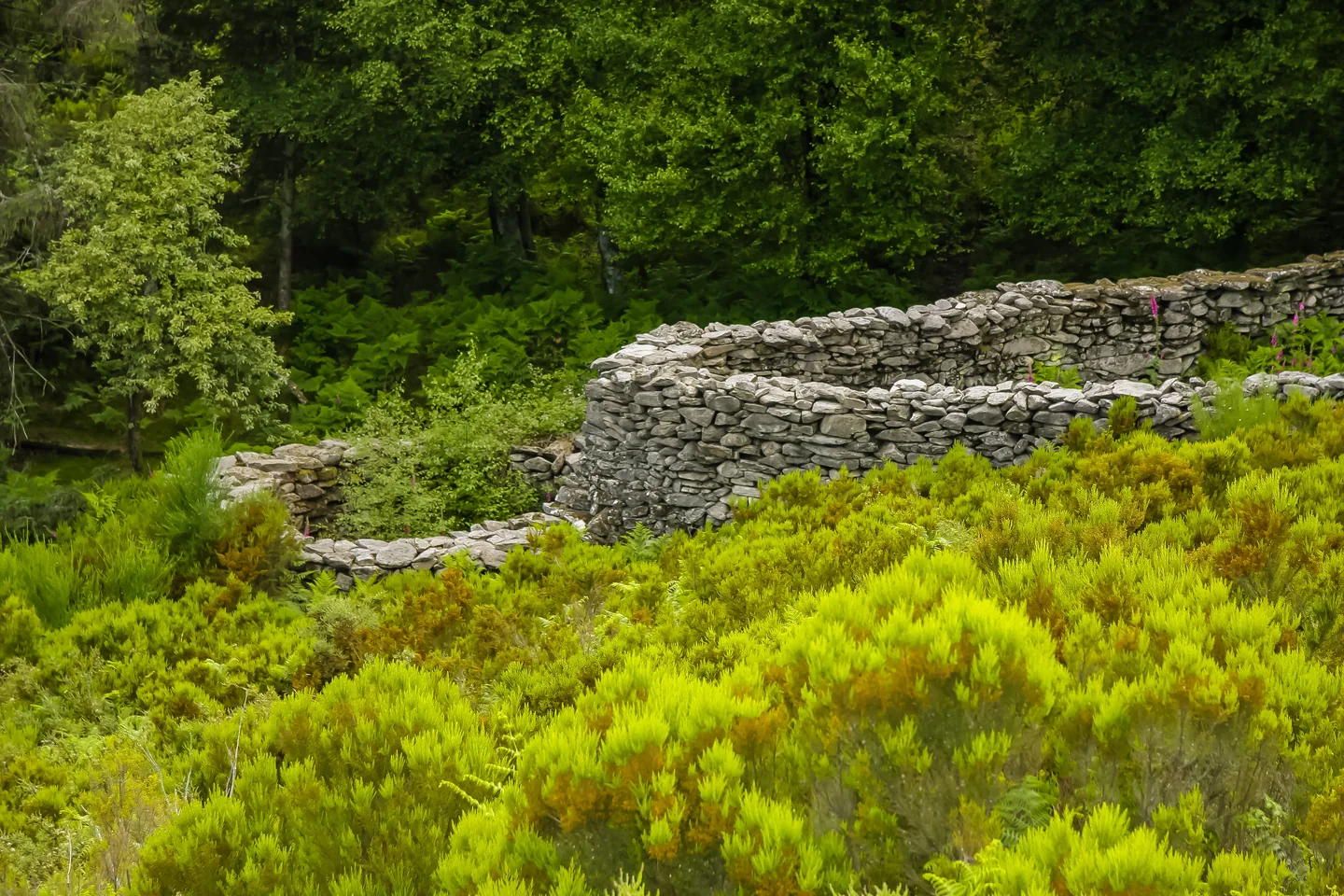
Two walls and a story of wolves

Stone walls of the wolf trap at Uz.
ⓘ

Stone walls of the wolf trap at Uz.

Source: Visit Cabeceiras — Município de Cabeceiras de Basto

View source

Photograph date not stated.

Individual photographer and reuse licence not stated by the source.

Request removal or correct the photo credit

Uz’s wolf trap records old forms of defensive hunting.

The inventory identifies a trap with V-shaped walls in Vilar de Cunhas. Its construction date remains uncertain: it discusses possibilities between the Early Modern period and the 19th century. One detail distinguishes it from other wolf traps: one wall rises towards the pit. The reading of figures on a slab is also uncertain, between 1668 and 1868. That doubt helps explain why the inventory does not settle on a single date.

Getting to know the parish Ver ficha: Fojo de Uz
Source and context

Municipality — archaeological inventory, interpretations and chronologies

Accessed: . Editorial summary; the date of consultation is not the date of the facts.

Back to index ↑
Alvite · the couto’s administration in 1758

One place, two jurisdictions

In 1758, not every matter was decided by the same authority.

The São Pedro de Alvite account distinguishes civil matters, linked with the abbot and convent of Refojos, from criminal matters, assigned to the judge of the municipality of Cabeceiras. The couto therefore had an organisation that cannot be reduced to a line on a map. This is a historical description, with no correspondence to current administration. One important territorial distinction remains: the answer places Petimão in the jurisdiction of Celorico de Basto. The couto’s powers are described for the other settlements, avoiding a reading of the whole parish as a single jurisdiction.

The territory seen by different rules

Open an option and choose the story.

  1. Who kept the chapels?Six chapels, different responsibilities →
  2. A later change of municipalityPassos changed municipality →
  3. A fair between places and parishesThe bulls came from Barroso →
Administrative and religious relations are not limited to a single frontier.
Getting to know the parish
Source and context

Basto Land Museum — Parish Memories of 1758: Alvite

Municipality — Alvite Parish Memories, 1758; transcription of José Viriato Chapel (2003)

Accessed: . Editorial summary; the date of consultation is not the date of the facts.

Back to index ↑
Passos · administrative change in the 19th century

Passos changed municipalities

Boundaries on a map have a history too.

In 1758, the parish account placed Passos within the jurisdiction of Celorico de Basto. The history published by Celorico’s municipality explains the change: during the administrative reforms of the 1830s and 1840s, Passos transferred to Cabeceiras. The source places the process in that period without giving a specific year for this transfer. Comparing the accounts helps explain why old documents from the same place may name different municipalities.

The change is not isolated in Celorico’s account: the same reorganisation transferred other parishes to Amarante, Felgueiras and Mondim. Passos should therefore be read in the context of the 19th-century Liberal reforms. Changing municipality changes an administrative connection; it does not mean the houses moved. When researching a family or property, the date of a document matters as much as the place name.

The same place, another administrative link

It opens every moment and discovers what the date represents.

  1. 1758 · In the term of Celorico

    The parochial memory is Passos in the municipality of Celorico of Basto.

  2. Decades of 1830 and 1840 · Reorganization of the territory

    The municipal history of Celorico includes in this period the passage from Passos to Cabeceiras.

The first date belongs to the parochial memory. The second interval is the framework given by the history of Celoric; it does not fix the day or year of transfer of Passos.
Getting to know the parish
Source and context

Celorico City Council of Basto — History, administrative changes in the decades of 1830 and 1840
Accessed:

Municipality — Parish memories of Passos, 1758
Accessed:

Editorial summary; the date of consultation is not the date of the facts.

Back to index ↑
YOUR LOCAL GUIDE

What would you like to discover?

Take a closer look.