Discover Cabeceiras de BastoFree independent guide
ViveCabeceirasYOUR GUIDE TO CABECEIRAS
ENEnglish
SearchSaved
CHOICE · EXPERIMENTARY · TAKE

A notebook.
Your findings.

Up to six proposals of Cabeceiras, in your own order, to do it at home, in company or on a break.

2 de 6 propostas escolhidas · faça-as ao seu ritmo.

PROPOSTA 1 DE 2 · The flavours of Cabeceiras

Compare two French toasts

Cabeceiras · 2012 memory and 2015 recipe

Honey sweetens rabanadas too

In the food programme of 23–25 March 2012, Cabeceiras presented roast kid as its speciality and rabanadas with honey as a regional sweet. The municipal announcement also links the table to Vinho Verde, meat and honey. This combination shows how food promotion brings products and preparations together. It is the historical programme of that edition, not a current menu or a claim that rabanadas originated exclusively in the municipality. The 2015 guide adds a preparation with milk and honey. Compare it with Dídia Teixeira’s wine version: the same name can hold different recipes.
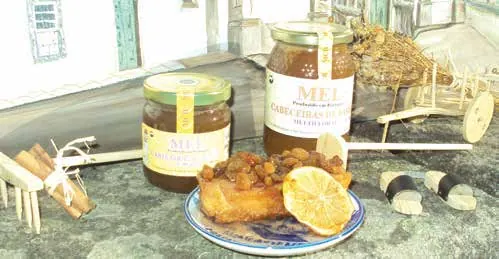
Honey rabanada in the Cabeceiras presentation in the 2014–2015 gastronomic guide.
ⓘ

Honey rabanada in the Cabeceiras presentation in the 2014–2015 gastronomic guide.

Source: Turismo do Porto e Norte de Portugal

View source

Photograph date not stated.

Individual photographer and reuse licence not stated by the source.

Request removal or correct the photo credit

Vamos experimentar?

  1. Open the recipes of honey and wine.
  2. Compares the liquid in which the bread is wet, the ingredients of the frying and the finish.
  3. Write down who shared each version and where it appears.

Comparison between documented recipes; does not presuppose a single preparation in all houses.

Open a história e os seus recursos →
Sources of this proposal

My findings

An idea, a drawing or a question to go on.

PROPOSTA 2 DE 2 · A world beneath the leaves

Try observing

General knowledge · national guide

The mushroom is only one part

A mushroom is a reproductive structure; the body of many fungi is a network of threads called mycelium. Each thread is a hypha. CCRES describes this network colonising living or decaying organic matter, from which the fungus obtains nutrients. The fruiting body develops from the mycelium and allows spores to disperse. If conditions are favourable, they can give rise to new mycelium. The visible mushroom tells only part of the life cycle; not all fungi produce cap-shaped structures. When some decomposer species are cultivated, mycelium can develop in inoculated logs. The same log can produce mushrooms for several years while conditions and nutrients remain suitable. This general explanation neither identifies a species nor documents its occurrence in Cabeceiras. The network can also form cords called rhizomorphs. In certain wood-inhabiting fungi, these help bridge gaps between branches or logs to reach another food source. An outer layer protects the inner hyphae during this exploration. Another strategy is to form sclerotia: compact masses of hyphae with a resistant covering. They allow fungi to survive unfavourable periods and, when conditions improve, can produce mycelium or reproductive structures. These are forms of growth and survival described by the Australian botanic gardens, not local records.

Vamos experimentar?

  1. Draw a network of wires on paper and, above, a mushroom.
  2. Tick the net as mycelium and choose a wire to represent a hyphae.
  3. Use the drawing as a scheme: it does not represent the shape or size of a real fungus.

An activity to try at your own pace, without collecting specimens.

Open a história e os seus recursos →
Sources of this proposal

My findings

An idea, a drawing or a question to go on.

YOUR LOCAL GUIDE

What would you like to discover?

Take a closer look.