Discover Cabeceiras de BastoFree independent guide
ViveCabeceirasYOUR GUIDE TO CABECEIRAS
ENEnglish
SearchSaved
CHOICE · EXPERIMENTARY · TAKE

A notebook.
Your findings.

Up to six proposals of Cabeceiras, in your own order, to do it at home, in company or on a break.

2 de 6 propostas escolhidas · faça-as ao seu ritmo.

PROPOSTA 1 DE 2 · The flavours of Cabeceiras

Compare two French toasts

Cabeceiras · 2012 memory and 2015 recipe

Honey sweetens rabanadas too

In the food programme of 23–25 March 2012, Cabeceiras presented roast kid as its speciality and rabanadas with honey as a regional sweet. The municipal announcement also links the table to Vinho Verde, meat and honey. This combination shows how food promotion brings products and preparations together. It is the historical programme of that edition, not a current menu or a claim that rabanadas originated exclusively in the municipality. The 2015 guide adds a preparation with milk and honey. Compare it with Dídia Teixeira’s wine version: the same name can hold different recipes.
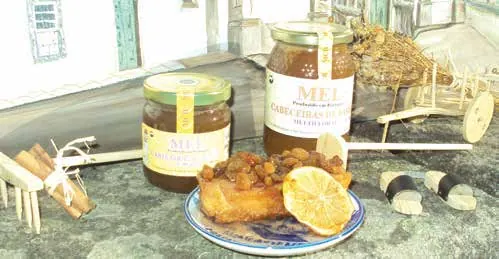
Honey rabanada in the Cabeceiras presentation in the 2014–2015 gastronomic guide.
ⓘ

Honey rabanada in the Cabeceiras presentation in the 2014–2015 gastronomic guide.

Source: Turismo do Porto e Norte de Portugal

View source

Photograph date not stated.

Individual photographer and reuse licence not stated by the source.

Request removal or correct the photo credit

Vamos experimentar?

  1. Open the recipes of honey and wine.
  2. Compares the liquid in which the bread is wet, the ingredients of the frying and the finish.
  3. Write down who shared each version and where it appears.

Comparison between documented recipes; does not presuppose a single preparation in all houses.

Open a história e os seus recursos →
Sources of this proposal

My findings

An idea, a drawing or a question to go on.

PROPOSTA 2 DE 2 · A world beneath the leaves

Draw a change under the ground

General ecology · mycorrhizae

Roots have partners

In mycorrhizas, a plant and a fungus form a partnership. The plant supplies organic compounds; the mycelium associated with the roots helps obtain water and nutrients. Oaks, chestnuts and pines can take part in these relationships. A nearby tree gives an observation context, but does not reveal a mushroom’s identity on its own. Researcher Susana Gonçalves also distinguishes ectomycorrhizas: in these associations, the fungus surrounds the root tips. This example shows that there are different kinds of relationships between plants and fungi, beyond the visible appearance of mushrooms. The partnership extends the area from which the plant can obtain resources: its roots connect with the fungal network. But the participants are not always the same. Some fungi can associate with several plants, while others have very specific partners. Knowing the trees in a place therefore helps us understand the environment without replacing identification of the fungus.

Vamos experimentar?

  1. Draws a plant with roots and a network of hyphae next to them.
  2. Draw an arrow from the plant to the fungus, with the legend organic compounds.
  3. Draw another in the direction of the plant, with water and nutrients; compare the scheme with the photographs, which show only the mushrooms.

General representation of a mycorriza, without stating which partnership is present in the local photographs.

Open a história e os seus recursos →
Sources of this proposal

My findings

An idea, a drawing or a question to go on.

YOUR LOCAL GUIDE

What would you like to discover?

Take a closer look.