Discover Cabeceiras de BastoFree independent guide
ViveCabeceirasYOUR GUIDE TO CABECEIRAS
ENEnglish
SearchSaved
CHOICE · EXPERIMENTARY · TAKE

Your notebook

Choose up to six ideas, try them and take your discoveries with you.

2 de 6 propostas escolhidas · faça-as ao seu ritmo.

PROPOSTA 1 DE 2 · A world beneath the leaves

Draws the food path

Reorder or remove

General biology · feeding of fungi

Vamos experimentar?

  1. Draws three boxes: organic matter, simple compounds and hyphae. Connects them and indicates where the enzymes act.
  2. It adds two zones to the drawing: one rich in food and another poor. It represents branching differences.
  3. Draws two separate pieces of wood and a cord that binds them. Compares this model with the explanation of the rhizomorphs.

A paper experience, without cultivating fungi or collecting specimens.

Discover the story

A meal prepared on the outside

A fungus does not need to swallow a leaf to use its nutrients. The mycelium releases enzymes outside itself; these break organic matter into simpler compounds, which the hyphae then absorb. The network of threads also grows and branches. Connections between hyphae allow nutrients to travel to other parts of the mycelium. Something that seems motionless may therefore be exploring new spaces and redistributing resources without a mushroom appearing on the surface. Growth also follows the distribution of food. The Australian National Botanic Gardens describe more branching and slower advance in nutrient-rich areas; where nutrients are scarce, hyphae may lengthen faster and branch less. The network does not always need the same density. Some fungi form cords of hyphae called rhizomorphs. These can help cross gaps between food sources, such as two separate pieces of wood. On reaching fresh wood, the hyphae may branch and occupy it. This explains growth strategies, not a confirmed description of any thread found on a walk.

Open a história e os seus recursos →
Sources of this proposal

My findings

An idea, a drawing or a question to go on.
PROPOSTA 2 DE 2 · Crafts and memories

Compare two portraits of Faia

Reorder or remove

Faia · sacred art, 2025

Vamos experimentar?

  1. Read the history of the chapels described in 1758 and this reading about the intervention of 2025.
  2. On a sheet, separate what each source describes: location and relationships with the community; materials, light and artistic creation.
  3. Write down a question that remains unanswered. The old reference does not allow dating each part of the current building.

A comparison of sources to make at home; does not require access to the interior of the chapel.

Discover the story

Roots and light renew a chapel

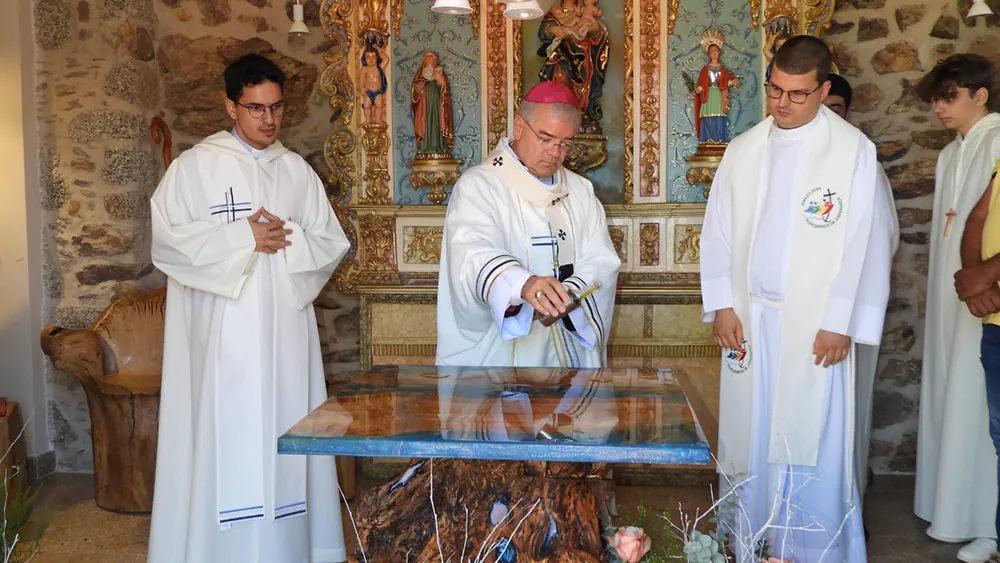
Olive-tree roots shaped the new altar and ambo in the chapel of Nossa Senhora do Amparo. The Archdiocese of Braga’s report of 6 October 2025 attributes the work to Atelier Amadeus and describes a refurbishment centred on the altar. A suspended cross forms part of the element called Corpo de Luz. Parish priest Rui Filipe Marques Araújo explained the lighting’s symbolism: groups of lights refer to the Trinity, the Evangelists and the Apostles. The publication also highlights the contribution of artists, technicians, workers and the community. The intervention shows heritage continuing to gain new forms and meanings; the 2025 report does not give visiting hours. The account presents the celebration, presided over by José Cordeiro, as a gathering of Faia with the communities of Arco de Baúlhe and Vila Nune. The choice of roots also receives a religious interpretation: according to the priest, transforming previously discarded material expresses renewal and redemption. This is the symbolic reading attributed to him in the report, distinct from the description of the materials. To understand the work, we can look at both layers: how it was made and the meaning given to it.

The altar of the Chapel of Nossa Senhora do Amparo during the celebration documented in October 2025.
ⓘ

The altar of the Chapel of Nossa Senhora do Amparo during the celebration documented in October 2025.

Source: Arquidiocese de Braga

View source

Photograph date not stated.

Autor e licença de reutilização não identificados na fonte.

Request removal or correct the photo credit

Open a história e os seus recursos →
Sources of this proposal

My findings

An idea, a drawing or a question to go on.

YOUR LOCAL GUIDE

What would you like to discover?

Take a closer look.