Discover Cabeceiras de BastoFree independent guide
ViveCabeceirasYOUR GUIDE TO CABECEIRAS
ENEnglish
SearchSaved
CHOICE · EXPERIMENTARY · TAKE

Your notebook

Choose up to six ideas, try them and take your discoveries with you.

2 de 6 propostas escolhidas · faça-as ao seu ritmo.

PROPOSTA 1 DE 2 · The flavours of Cabeceiras

One name, several lands

Reorder or remove

Cabeceiras · Vine vocabulary

Vamos experimentar?

  1. Write Arinto in the center of a leaf and connect it to Pé de Pardiz, Pedernã and Perdigão.
  2. Add to each name the territory referred to in this reading. Then make a second group for Borraçal, Bogalhal and Eye of Frog.
  3. If you pick up a name in a conversation, write down who uses it and where.

An activity to try at your own pace, without collecting specimens.

Discover the story

A partridge’s foot, but in the vineyard

The Vinho Verde wine commission identifies Pé de Perdiz as a name for Arinto in Cabeceiras de Basto. It also mentions Pedernã in the region and Perdigão in Mondim. Knowing these names helps when listening to vineyard stories: a local name does not, by itself, mean a different grape variety. The CVRVV profile adds large, compact bunches with small berries. The variety is used both in wines made only from Arinto and in blends of white grape varieties. Traditional name, grape appearance and wine composition are three different ways into the same story.

Open a história e os seus recursos →
Sources of this proposal

My findings

An idea, a drawing or a question to go on.
PROPOSTA 2 DE 2 · Travel through time

Comparing arc shapes

Reorder or remove

History of Cavez Bridge

Vamos experimentar?

  1. Draw an arc pointed and another semicircular, from the descriptions.
  2. Associate the three central openings and the two sides to the forms indicated in the text.
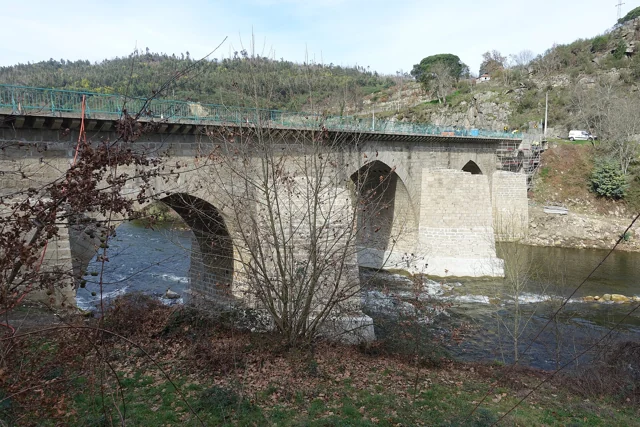
  3. Note the partial photograph: Mark only the visible arches without completing the frame as if you were seeing them all.

Reading and drawing exercises; schemes do not reproduce the dimensions of the bridge.

Discover the story

Five arches, more than one era

Three central pointed arches and two round arches beside the banks: the Bridge of Cavez brings together different forms and periods. The Museum dates the medieval construction to the second half of the 13th century, serving the road between Braga and Vila Pouca de Aguiar. The source attributes the round arches to work during Philip II’s reign and mentions a marker from 1599. In the 19th century, the road between Fafe and Vila Pouca de Aguiar brought a widening of the deck. Looking at the bridge means seeking the changes in an old crossing. According to the Museum, the stone bridge replaced an earlier wooden one that had deteriorated. Construction is attributed to Frei Lourenço Mendes, a Dominican who collected alms for the work; the museum text mentions testamentary bequests supporting that connection. The crossing thus involves materials, routes and ways to fund a shared undertaking.

Cavez Bridge over the Tâmega River, with stone arches, a deck and tree-lined banks.
Partial view of the Ponte de Cavez over the Tâmega.© Joseolgonⓘ
Open a história e os seus recursos →
Sources of this proposal

My findings

An idea, a drawing or a question to go on.

YOUR LOCAL GUIDE

What would you like to discover?

Take a closer look.