Up to six proposals of Cabeceiras, in your own order, to do it at home, in company or on a break.
3 de 6 propostas escolhidas · faça-as ao seu ritmo.
PROPOSTA 1 DE 3 · Crafts and memories
Compare two solutions
Alvite and Passos · irrigation documented in 2008
The water changed its path
The municipal record for Poça do Monte, surveyed on 14 April 2008, describes a change in Alvite: the shared users piped the natural-ground channel in 2001. It was about one kilometre long and used water from the Ribeiro Furado spring.
The record identifies seven shared users and mentions a steep initial slope. This story helps distinguish the old open channel from piped water conveyance. The document cannot establish the network’s condition today and does not present a walking route.
Vamos experimentar?
Split a sheet into two columns: before and after.
Note the change described in the text and the date of the source.
Write a question the document leaves open.
Exploitation of the document, no visit to the real estate.
The inventory recalls confrontations at fairs and pilgrimages, in a rural setting where the staff served as support and defence. It distinguishes that past from the cultural practice of demonstrations. Understanding this change lets us see Jogo do Pau as a tradition that adapted to communities and times.
The record connects the transformation with changes in rural society and transmission between generations. In demonstrations, it highlights training, attention and decision-making. The schools of Abadim and Bucos appear as places of learning in the inventory process. The same object gains a different social setting: knowing its history includes understanding why people practise and how they learn.
Vamos experimentar?
It makes two columns: context of conflict and cultural presentation.
Note what changes in purpose and what continues to depend on learning.
Distinguish the story told in the inventory of a training announcement or current show.
An activity to try at your own pace, without collecting specimens.
Gondiães and Vilar de Cunhas · memory and landscape
A house with three granaries
At Casa de Chouzas, three 19th-century granaries stand alongside the manor house highlighted by the municipality. The group connects two functions: living and storing the harvest. Rather than looking only at the main house, it is worth recognising the importance of buildings supporting agriculture.
The introduction to Vilar de Cunhas places this heritage in a landscape of plateau and mountain, shaped by farming and pastoralism. House and granaries can be read in that working context, although the source does not detail each property’s production.
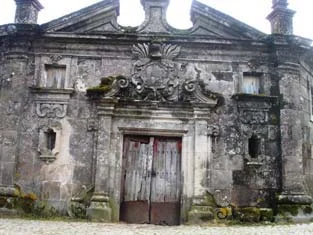
The house’s dating is less firm: the municipality presents it as perhaps 19th-century, while assigning the granaries to the 19th century. That difference should remain visible. The photograph accompanying the reading shows the portal, not the three granaries. The heritage reference does not confirm access to the group.
Portal da Casa de Chouzas · photo of the municipal inventory; the granaries do not appear in this framework.ⓘ
Vamos experimentar?
Look at the photo of the portal and list only the elements you can see.
Compared to the three granaries mentioned in the text: what depends on the written description?
Imagine a caption that distinguishes the frame of the photograph from the remaining patrimonial set.
An activity to try at your own pace, without collecting specimens.