Discover Cabeceiras de BastoFree independent guide
ViveCabeceirasYOUR GUIDE TO CABECEIRAS
ENEnglish
SearchSaved
5 STORIES · CONTINUOUS READING

Five encounters with nature

From the corner of a jump to the wings of a fruit: discover five stories with photographs registered in the municipality. A reading route, to explore at your pace.

All stories in the order of the route. You can print this page by the browser; sources and credits follow the reading.

Things to try5 activities · 4 interactive explorations · 4 questions
Species biology · photograph recorded in the municipality

A song hidden in the greenery

Sometimes an insect is heard before it is seen.

The great green bush-cricket, Tettigonia viridissima, can go unnoticed among leaves and branches. According to the Gulbenkian profile, adult males reveal themselves by their song, while both males and females tend to hide in dense vegetation. The species occurs in habitats with shrubs and trees, including vegetable gardens and urban green spaces.

Nymphs already resemble adults but have poorly developed wings. Comparing life stages is different from identifying behaviour: the photograph recorded in Cabeceiras shows the insect on wood, without documenting its song. The image’s background is also not enough to describe the whole habitat where it was observed.

Developmental stage also changes what is easiest to observe. The profile suggests looking for nymphs among herbs and shrubs, while adults often remain hidden. Sound and images offer different clues: hearing a song without seeing the animal and photographing an insect without hearing it are not equivalent records. With the local photograph, keep to what the frame allows you to recognise.

Sound, light or image?

Open an option and choose the story.

  1. Date changes question

    A September meeting does not itself document winter.

    A grasshopper crosses winter →
  2. The light also communicates

    In fireflies, light signals are part of communication.

    A light that carries a message →
  3. A discreet bird has another voice

    It compares the importance of singing without confusing birds and insects.

    A discreet bird that reveals itself in the corner →
General biology comparisons; local records are identified at each reading.
Return to observation proposal ↑
Source and context

Calouste Gulbenkian Foundation — Great Green Rocket

Accessed: . Editorial summary; the date of consultation is not the date of the facts.

Back to index ↑
Species biology · photograph recorded in the municipality

A grasshopper makes it through winter

The name Egyptian grasshopper does not confine the species to one country.

The name Egyptian grasshopper does not confine Anacridium aegyptium to one country. The Gulbenkian profile describes its distribution across parts of Europe, North Africa and the Middle East, and its presence in mainland Portugal in orchards, gardens, scrub and open woodland.

At the Gulbenkian Garden in Lisbon, adults are described as surviving the winter and basking on trees and shrubs on bright days. This observation helps explain the species, but cannot automatically be transferred to Cabeceiras. The local photographic record was made in September: it shows an encounter on that date, not winter behaviour in the municipality.

The Lisbon garden’s description mentions observation sites including rosemary hedges, strawberry trees, olive trees and other evergreen trees. Vegetation enters the story as part of the habitat adults use. These references do not tell you where to look for the grasshopper in Cabeceiras; they help explain why a profile can bring together an insect, a season and plants. When comparing the September photograph with the winter account, always record date and place separately.

Return to observation proposal ↑
Source and context

Calouste Gulbenkian Foundation — Anacridium aegyptium

Accessed: . Editorial summary; the date of consultation is not the date of the facts.

Back to index ↑
Species biology · photograph recorded in the municipality

Wing patterns tell a story of plants

A closer look at wings leads to the small world of grasses and herbs.

A photograph of Cymbalophora pudica offers a close look at its wing pattern. The Naturdata profile gives a wingspan of 35 to 43 millimetres: the distance between the tips of the open wings, not body length. This measurement comes from the species profile; it was not calculated from the local photograph.

The same source associates the species with the plant genera Taraxacum and Plantago, gives a flight period from August to October, and describes a distribution across the Iberian Peninsula, the Balearic Islands and North Africa. These details place the individual in a wider context.

The municipality’s photographic record, made in October, shows a particular encounter. It does not demonstrate the individual’s relationship with those plants or measure abundance or flight season in Cabeceiras. The image and profile answer different questions: one documents an encounter; the other brings together general species characteristics.

Wings, plants and observation

Open an option and choose the story.

  1. What happens on a flower visit?From flower to flower, a shared task →
  2. The flowers throughout the yearA flower calendar →
  3. Another way to look at the wingsThe inn wings give a clue →
It goes from photography to relationships and compares the questions of each reading.
Return to observation proposal ↑
Source and context

Naturdata — Cymbalophora pudica

Accessed: . Editorial summary; the date of consultation is not the date of the facts.

Back to index ↑
Species botany · with a local observation

A fruit with a wing

For ash, shape helps fruit travel.

The ash fruit has a wing and is called a samara. There is another detail to discover: the leaf is divided into several narrow leaflets. Do not confuse each leaflet with a whole leaf.

Fraxinus angustifolia can grow in riverside woods and on slopes. The local photograph documents a tree in Gondiães e Vilar de Cunhas; it does not show a fruit travelling or describe the species’ entire habitat.

The Gulbenkian profile describes leaves with three to eleven leaflets and serrated edges. The name angustifolia refers to this narrow shape. On the fruit, the wing extends beyond the seed-bearing part: fruit and seed are not the same structure. The tree loses its leaves seasonally; branches, leaves and fruits offer different clues throughout the year.

Ash connects this leaf shape with water availability. The Gulbenkian profile mentions tolerance of a range of temperatures but sensitivity to dryness, and a preference for deep soils. It also describes a tall, irregular crown and a dark, deeply cracked trunk. Leaves are not the only helpful feature: bark, crown and surroundings complete the observation, without any single characteristic being enough to identify a tree.

Three Ways to Continue the Trip

Open an option and choose the story.

  1. Seeds that travel by waterSeeds that travel through water →
  2. Seeds protected in a pine coneA pine cone has small seed houses →
  3. A tree inside a forestThe river also has a forest →
Compare the ash fruit’s wing with other forms of dispersal and with life along riverbanks.
Return to observation proposal ↑
Source and context

University of Évora — BioMontado, chips Fraxinus angustifolia and Hedera hibernica

Portuguese Society of Botany — Flora-On, Fraxinus angustifolia: ecology

Calouste Gulbenkian Foundation — Straits leaves, fruit and habitat

Accessed: . Editorial summary; the date of consultation is not the date of the facts.

Back to index ↑
Species biology · with a local record

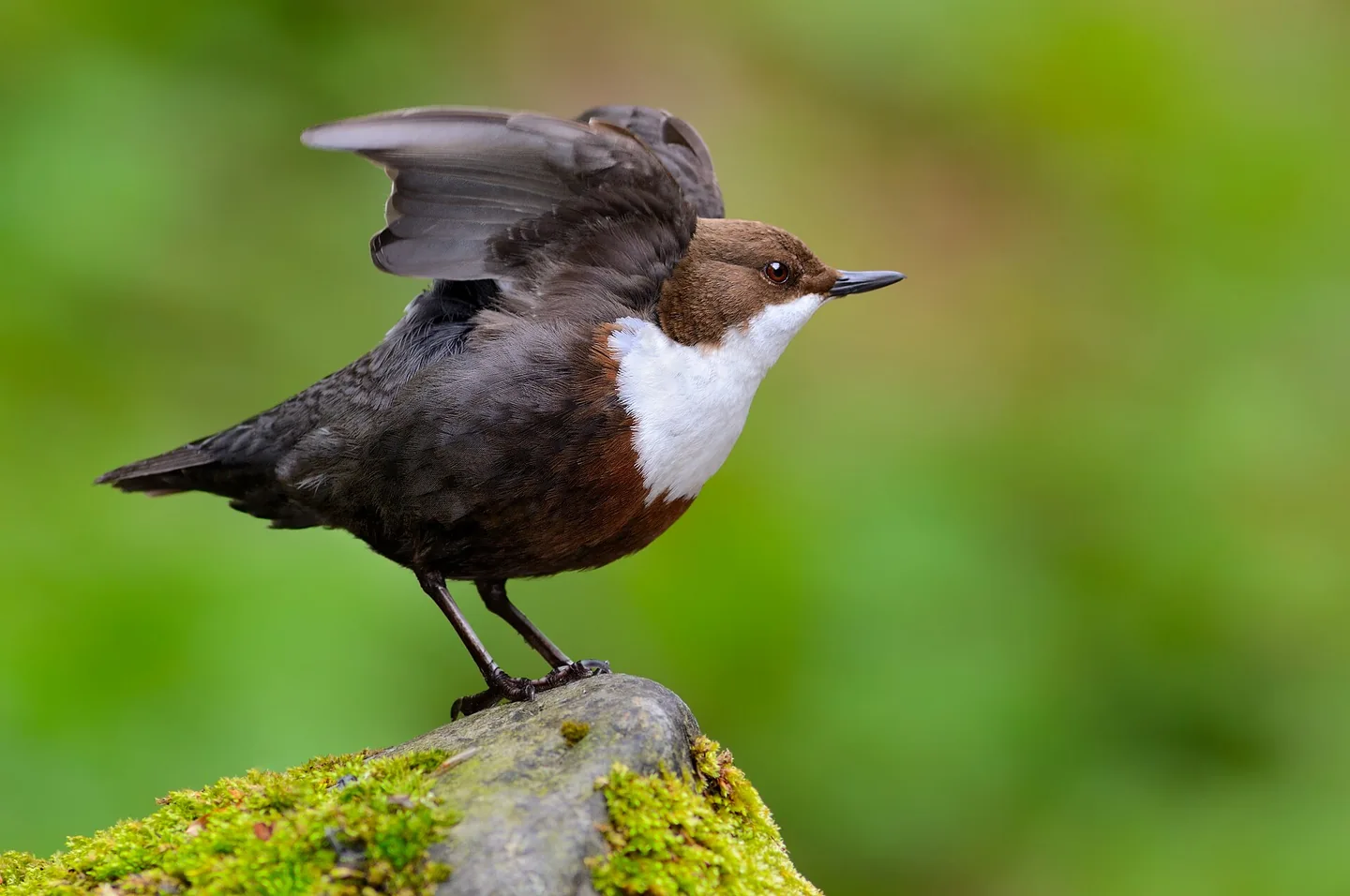
A small bird that dives

White-throated dipper with open wings.
White-throated dipper with open wings.Illustrative photograph
Олексій Карпенко
ⓘ

White-throated dipper with open wings.

Photography: Олексій Карпенко · CC BY-SA 4.0

View source

Date given at source: .

Request removal or correct the photo credit

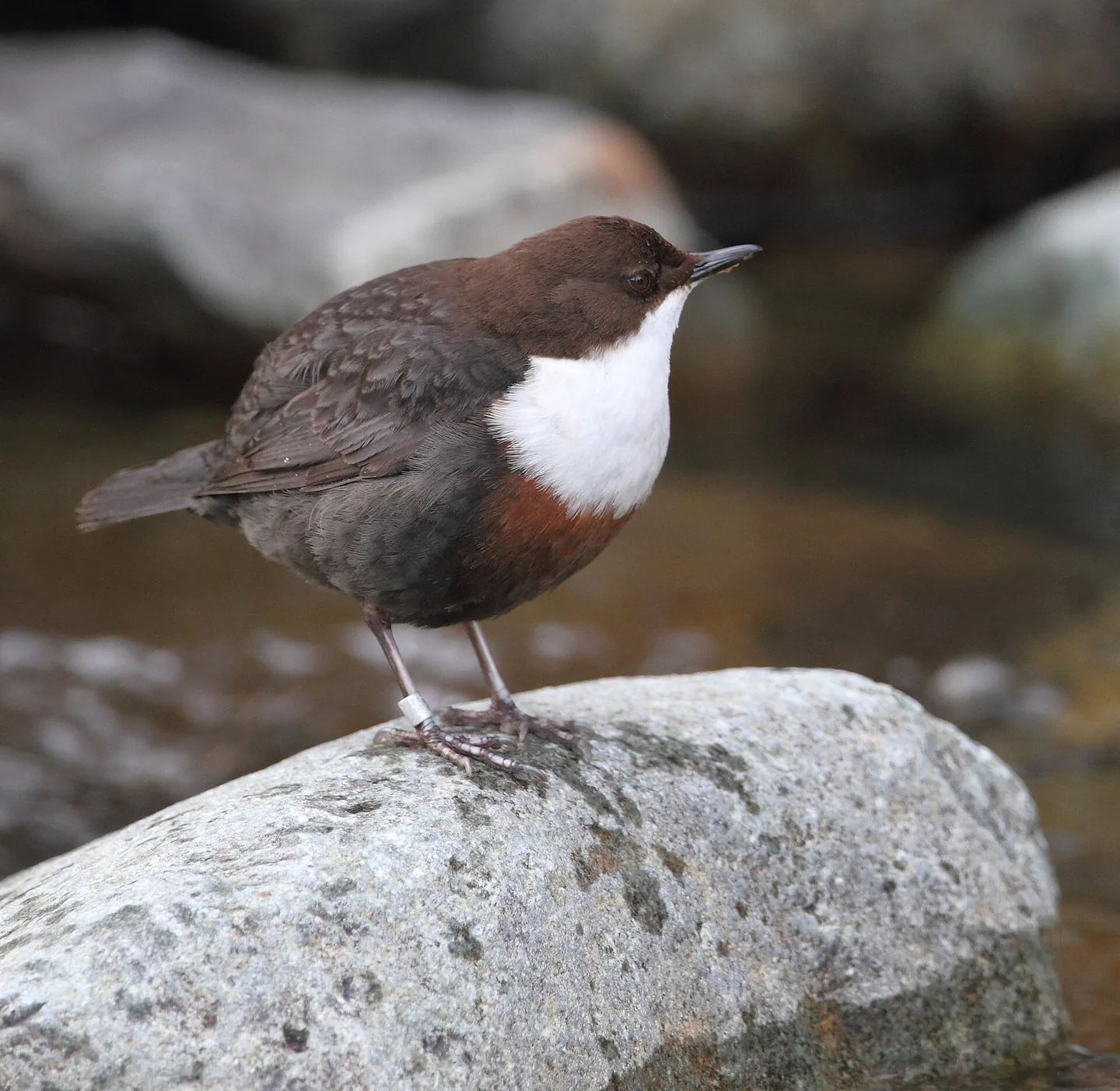
The white breast of a dipper.
The white breast of a dipper.Illustrative photograph
Alun Williams333
ⓘ

The white breast of a dipper.

Photography: Alun Williams333 · CC BY-SA 4.0

View source

Date given at source: .

Request removal or correct the photo credit

The white-throated dipper brings birdwatching into the current.

A compact body, short tail and white breast in adults offer clues to Cinclus cinclus, the white-throated dipper. This bird can dive and is associated with fast-flowing streams, especially in mountains. The gallery includes a local record; the photograph shows the bird in a hand, not the diving behaviour described here. Aves de Portugal describes fast, direct flight and classifies the species as resident: it may remain in breeding areas throughout the year. That general trait does not confirm a continuous presence at the local record’s location.

Underwater, the food it seeks includes small invertebrates. The BTO describes the bird entering the current from rocks or flying low to another perch. The stream is therefore a feeding space, not simply a backdrop where the bird appears.

Age also changes its appearance: juveniles are greyer and more mottled than white-breasted adults. This biological comparison does not assign an age to the photographed bird. A record shows an encounter; understanding what a species does requires bringing together other observations and sources.

The stream is more than water

Open an option and choose the story.

  1. Small animals with their own sheltersSmall shelters underwater →
  2. The vegetation accompanying the currentThe river also has a forest →
  3. How Life Helps to Study RiversThe life of the river also tells a story →
These relationships explain the environment; they do not confirm that animals from different readings share the same point.
Return to observation proposal ↑
Source and context

Birds of Portugal — Watermelon, identification, habits and distribution

British Trust for Ornithology — BirdFacts: Dipper, Cinclus cinclus

Accessed: . Editorial summary; the date of consultation is not the date of the facts.

Back to index ↑
YOUR LOCAL GUIDE

What would you like to discover?

Take a closer look.