Discover Cabeceiras de BastoFree independent guide
ViveCabeceirasYOUR GUIDE TO CABECEIRAS
ENEnglish
SearchSaved
12 STORIES · CONTINUOUS READING

Gondiães e Vilar de Cunhas: do and share

Twelve stories link documents, villages, bridges, water, crafts and sharing of the popes. Draws the levada of the neighborhood, compares materials and discovers the people behind the memories. It is a path of reading, without implicit visits or events.

All stories in the order of the route. You can print this page by the browser; sources and credits follow the reading.

Things to try12 activities · 4 interactive explorations · 8 questions
Gondiães and Vilar de Cunhas · published notes on 1758

Two old portraits, two ways of counting

A short note can open a window onto history too.

The municipal transcription of 1758 presents Gondiães with 55 households and 269 people admitted to communion, alongside the parish church dedicated to Saint Martin. The account of Vilar records 41 households and 141 people admitted to the sacraments, with a church dedicated to Saint Lawrence. Both places are situated within Cabeceiras de Basto’s jurisdiction, in the district of Guimarães.

The source’s terms matter: fogos or vizinhos, meaning households, and almas, meaning souls, are not the same category. These figures should not be added as though they all counted people, nor should people admitted to the sacraments be presented as a modern census of the entire population. The Gondiães text attributes its information to Lima; that reference should accompany the figures.

Source and context

Municipality — Parish Memoirs of Gondiães (1758), transcript published from José Viriato Chapel (2003)

Municipality — Parish Memoirs of Vilar de Cunhas (1758), reference to José Viriato Chapel (2003)

Accessed: . Editorial summary; the date of consultation is not the date of the facts.

Back to index ↑
Gondiães and Vilar de Cunhas · memory and landscape

Vilar looks towards the Beça

Houses, hillside and water shape the village landscape.

The municipal village guide highlights Vilar’s church and thatched buildings on a slope facing the Beça landscape. Its description connects built heritage, farming, livestock and crafts.

Reading that introduction invites you to connect different scales: a house’s roof, the village as a whole and the valley opening before it. This is a way to explore the territory through documented features, not current confirmation of every roof’s condition or access to the river.

The guide grew from a partnership between Cabeceiras de Basto and Vieira do Minho through the Serra da Cabreira Interpretation and Activities Centre. Its introduction seeks to bring visitors closer to the villages and their people. In Vilar, landscape is connected with work: fields, livestock and crafts help us read the place beyond its valley view.

From the slope to the paths

Open an option and choose the story.

  1. Bridges and their materialsThree bridges, three stories of passage →
  2. What Counts UndergroundNot all stone is granite →
  3. The villages and the namesBefore Vilar, Vila Seca →
Readings about documented elements of the landscape, without constituting a pedestrian route.
Getting to know the parish
Source and context

Municipality — Village Guide of Serra da Cabreira: landscape, work and heritage

Accessed: . Editorial summary; the date of consultation is not the date of the facts.

Back to index ↑
Gondiães · heritage recorded in an inventory; current access unverified

Three bridges, three stories of passage

A bridge’s name does not tell its whole construction story.

The municipal inventory links the Ponte de Arame de Padroselos to tin mining. Entry Po.27 describes iron, wood and a ruined condition, without supplying the survey date.

Ponte do Freixo, in Torneiro, formed part of the path between Cunhas and Torneiro. Entry Po.28 records granite and an absence of parapets. In Po.29, Ponte de Arames over the Beça appears with a concrete deck supported by five piers. These two entries are dated 20 March 2008.

These are three different references. The inventory reveals the memory of connections but does not confirm present conditions or suggest crossings.

Source and context

Municipality — Inventory of bridges, tokens Po.27–Po.29, PDF pages 28–30; Po.28 and Po.29 raised in 20/03/2008, Po.27 without completed date

Accessed: . Editorial summary; the date of consultation is not the date of the facts.

Back to index ↑
Gondiães · 2008 municipal inventory

Four pools and a shared irrigation channel

In Gondiães, storing and directing water was collective work.

Four pools supplied a shared structure. The municipal record of 20 March 2008 describes the Rego das Poças, also called Levada da Vizinhança, in Gondiães: around two kilometres of channel for irrigation and milling, serving the Tarroeiro mill.

The Poças do Lugar lay at Olheiros. Three were close together and the fourth further away. Up to the village entrance, the channel followed natural ground; within the settlement it became a stone trough. Storing and directing water therefore required different elements and materials.

The inventory identifies collective ownership and operation by the channel’s joint users, or consortes. It records seasonal water turns but leaves the construction period undetermined. The survey date is not the structure’s age. Its recorded use and condition belong to the picture of 2008, without confirming today’s situation or access.

Store, drive and distribute

Open an option and choose the story.

  1. Two puddles and other usesTwo puddles, shared water →
  2. The water also had a given timeThe water had its turn →
  3. When the water put the mills to workPeio also made flour →
Compares different documented solutions in the municipality.
Source and context

Municipality — inventory of levadas, fiche L29: Rego das Poças, withdrawal of 20/03/2008

Accessed: . Editorial summary; the date of consultation is not the date of the facts.

Back to index ↑
Cunhas · heritage and legends in the municipal guide

A village, a manor house and two legends

In Cunhas, built heritage meets oral tradition.

The municipal village guide highlights a compact group of old houses and the Teixeiras Pereiras manor house in Cunhas. This is a reference to the village’s architecture, without any indication of access to the building’s interior.

The same guide tells two legends: one links the name Cunhas to a soldier called Cunha de Pau, associated with fighting the Moors; the other says that Saint Senhorinha once had a house in the village. These are stories from popular memory. The publication does not present them as proven events or enable a house belonging to the saint to be located.

Source and context

Municipality — Village Guide of Serra da Cabreira: landscape, work and heritage

Accessed: . Editorial summary; the date of consultation is not the date of the facts.

Back to index ↑
Gondiães · historical link to the Barrosã breed

Barrosã cattle helped work the land

Before the meal comes a story of fields and animals.

CAPOLIB includes Gondiães in the historic home territory of the Barrosã breed. It describes cattle linked with work and meat production, adapted to mountain farming: they help work small plots, and their manure fertilises the soil. This connects animal heritage with rural life; it is not a survey of the herds currently present in the parish.

Source and context

CAPOLIB — Barrosan breed, historical area and designation of origin

Accessed: . Editorial summary; the date of consultation is not the date of the facts.

Back to index ↑
Gondiães and Vilar de Cunhas · memory and landscape

Wool became socks too

Small pieces belong to the memory of crafts.

Woollen socks appear in the municipal portraits of Gondiães and Vilar de Cunhas. For Vilar, the source also mentions lace.

Crafts live in small pieces too, alongside blankets and capuchas. The reference describes a local repertoire without identifying workshops or makers currently available.

The introduction to Vilar de Cunhas places Vilar, Cunhas and Uz in a landscape of plateaus and mountains, mentioning farming and pastoralism. This setting brings crafts close to rural daily life. It does not, however, establish which flocks supplied the wool for each piece or describe the lace-making technique.

Compare without confusing: a woollen sock, a blanket and a linen cloth are not the same object and do not necessarily require the same gestures. The stories about Bucos and spinning help explore materials and tools; the municipal reference to Vilar preserves the particular place of socks and lace.

Small pieces, long stories

Open an option and choose the story.

  1. The wool worked in BucosDress the mountains →
  2. From wiring to fabricYarn is not weaving →
  3. When fabrics enter the footwearLinen and wool have gained new steps →
It follows the thread between the documented crafts in different villages.
Getting to know the parish
Source and context

Municipality — Gondiães e Vilar de Cunhas, landscape, heritage and crafts

Accessed: . Editorial summary; the date of consultation is not the date of the facts.

Back to index ↑
Gondiães and Vilar de Cunhas · memory and landscape

A house with three granaries

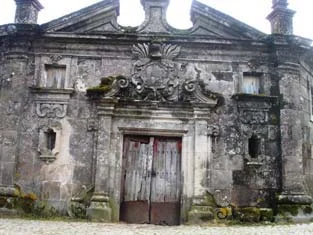
Municipal archive photograph: Casa de Chouzas.
Portal da Casa de Chouzas · photo of the municipal inventory; the granaries do not appear in this framework.ⓘ

In Chouzas, the heritage of homes meets that of harvests.

At Casa de Chouzas, three 19th-century granaries stand alongside the manor house highlighted by the municipality. The group connects two functions: living and storing the harvest. Rather than looking only at the main house, it is worth recognising the importance of buildings supporting agriculture.

The introduction to Vilar de Cunhas places this heritage in a landscape of plateau and mountain, shaped by farming and pastoralism. House and granaries can be read in that working context, although the source does not detail each property’s production.

The house’s dating is less firm: the municipality presents it as perhaps 19th-century, while assigning the granaries to the 19th century. That difference should remain visible. The photograph accompanying the reading shows the portal, not the three granaries. The heritage reference does not confirm access to the group.

The harvest also had architecture

Open an option and choose the story.

  1. The canasters of another villageThe corn left mark in the village →
  2. Getting to know the way of cerealsBefore the bread, there was a field →
  3. Another house between history and traditionA village between a manor and two legends →
Compares constructions and works related to cereals.
Getting to know the parish See Fact sheet: Casa de Chouzas
Source and context

Municipality — Gondiães e Vilar de Cunhas, landscape, heritage and crafts

Accessed: . Editorial summary; the date of consultation is not the date of the facts.

Back to index ↑
Gondiães · organising the celebration in 2012

A house organised the celebration

Cooking below; food waiting for the table above.

In the account of the 2012 visit, the Casa do Mártir São Sebastião followed the slope of the ground over two floors. The oven, fire, pots and kneading equipment were downstairs.

Prepared food and serving equipment gathered upstairs: the house connected preparation with distribution. This arrangement belongs to the record of that visit, without confirming the layout today.

The upper floor also held the table’s presentation: broa on shelves decorated with coloured cut-out paper, papas in bowls and pork ribs on glazed earthenware plates. Long linen cloths covered the benches used as tables. The materials show that preparing the celebration meant cooking, storing, carrying and arranging food.

Getting to know the parish
Source and context

Basto Land Museum — Visit to the Feast of Popes, published in 22/01/2012

Accessed: . Editorial summary; the date of consultation is not the date of the facts.

Back to index ↑
Gondiães · changes documented in 2012

Broa gained a new tool

Tradition also takes in new ways of working.

The 2012 record contrasts the wooden kneading trough with the mechanical mixer then used in Gondiães. It also recalls the move from the communal oven to the Casa do Mártir.

Ingredients, previously donated by residents, came to be purchased. Changes in tools and supplies coexisted with collective preparation for the celebration.

Help also came from people living abroad. The Museum gathered testimonies from emigrants who travelled from Lyon to take part and lend a hand. Remembered tasks included carrying flour and firewood. The move to a mechanical mixer did not remove these jobs: machines, materials and people remained part of the same preparation.

Getting to know the parish
Source and context

Basto Land Museum — Visit to the Feast of Popes, published in 22/01/2012

Accessed: . Editorial summary; the date of consultation is not the date of the facts.

Back to index ↑
2012 account · Gondiães

A rod measures the sharing

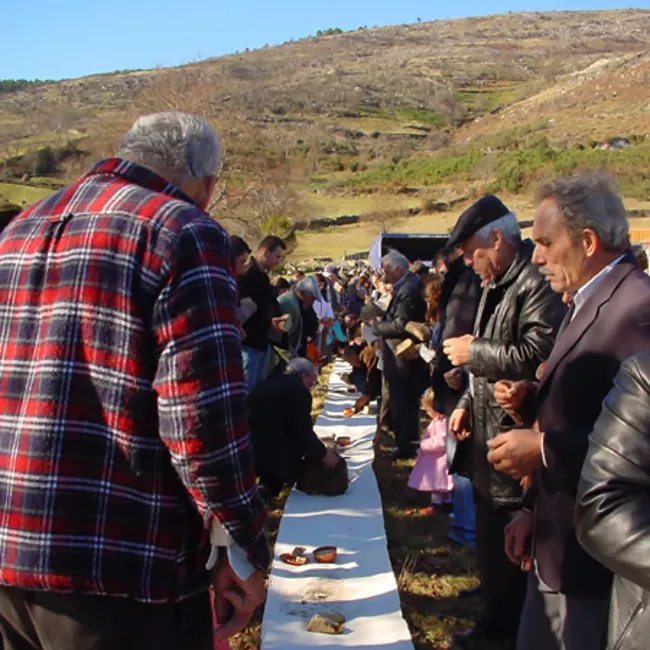
Sharing at the table during Samão’s Festa das Papas, in the municipal documentation.
ⓘ

Sharing at the table during Samão’s Festa das Papas, in the municipal documentation.

Source: Municipality of Cabeceiras de Basto

View source

Photograph date not stated.

Individual photographer and reuse licence not stated by the source.

Request removal or correct the photo credit

At the Festa das Papas, serving is a ritual too.

During the January 2012 visit to Gondiães, a rod marked the spaces between sets of broa, pork ribs and papas on the tables. Each group then shared those foods among its participants. Preparation brought residents together with emigrants who had returned.

The piece of broa was called a carolo. The account presents Saint Sebastian’s protection as an origin legend, without documentation fixing the celebration’s beginning.

Getting to know the parish
Source and context

Basto Land Museum — Visit to the Feast of Popes, published in 22/01/2012

Accessed: . Editorial summary; the date of consultation is not the date of the facts.

Back to index ↑
Heritage and community · Samão

Keeping Samão’s memory alive

Studying heritage is also a way of caring for a place.

Preserving memory can also be the work of an association. The municipality presents GAS — Grupo Associativo do Samão as a cultural and recreational organisation based in Samão, dedicated to recording, studying and sharing the region’s natural, historical and ethnographic heritage.

Recording, studying and sharing are different tasks: documenting an object or testimony is a beginning; understanding its context and passing it on continues the work. The municipal description documents the association’s aims without confirming a current programme of activities.

Getting to know the parish
Source and context

Municipality — cultural association

Accessed: . Editorial summary; the date of consultation is not the date of the facts.

Back to index ↑
YOUR LOCAL GUIDE

What would you like to discover?

Take a closer look.