Discover Cabeceiras de BastoFree independent guide
ViveCabeceirasYOUR GUIDE TO CABECEIRAS
ENEnglish
SearchSaved
6 STORIES · CONTINUOUS READING

mountains animals, stories of people

Six readings link the domestic Garrano, the shepherding and fauna described in 1758 to the food and family life of the wolf. Compares sources and draws a changing pack. Memories and regional references are not sighting routes.

All stories in the order of the route. You can print this page by the browser; sources and credits follow the reading.

Things to try4 activities · 3 interactive explorations · 2 questions
Cabeceiras and Serra da Cabreira · documented distribution of the breed

A small horse with a mountain stride
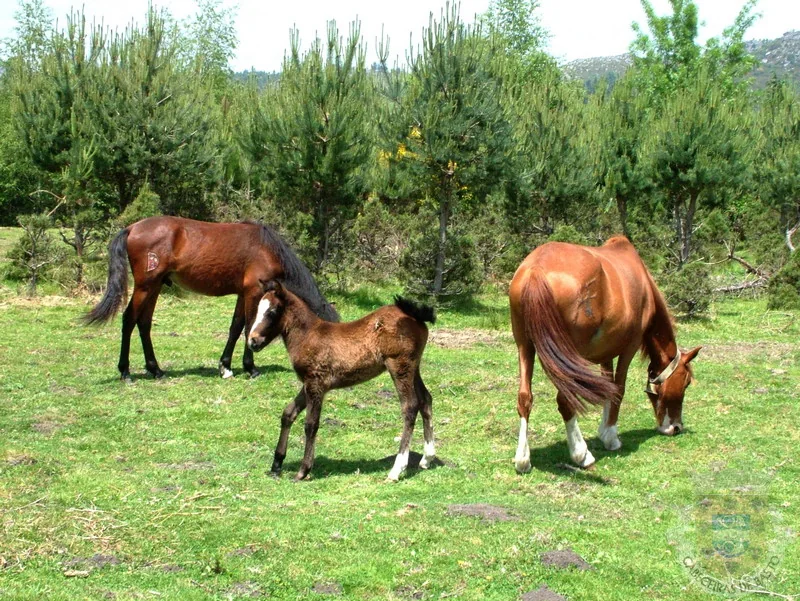
Garranos in Serra da Cabreira. Archive photograph; date unidentified.
ⓘ

Garranos in Serra da Cabreira. Archive photograph; date unidentified.

Source: Municipality of Cabeceiras de Basto

View source

Photograph date not stated.

Autoria individual e licença de reutilização não identificadas na página consultada. A fonte não equivale ao autor.

Request removal or correct the photo credit

The Garrano is part of north-western Portugal’s living heritage.

The DGAV catalogue includes Cabeceiras de Basto in the Garrano breed’s breeding area and mentions its presence in Serra da Cabreira. It describes brown horses, sometimes dark brown, with an adult height below 1.35 metres at the withers. Their gaits suit mountain paths. Even when kept free-ranging, the Garrano is a domestic horse. The documented distribution connects the breed with the territory, without guaranteeing encounters on a trail or identifying a particular herd.

The breed standard describes a compact body, short strong limbs, and a black mane and tail. Its uses are not limited to riding: they include carrying loads, draught work and farm work. The horse belongs to a landscape also shaped by people, where its way of moving has practical importance.

The catalogue distinguishes passo travado from andadura. It describes four beats in the first; in andadura, the limbs on the same side lift and land together, producing two beats per stride. These are descriptions of movements, not two names for the same gait. This detail helps explain why a breed’s heritage includes more than appearance.

Source and context

DGAV — Garrana, distribution and pattern of race, p.2
Accessed:

Município — galeria de paisagens, fotografias sem data identificada
Accessed:

Editorial summary; the date of consultation is not the date of the facts.

Back to index ↑
São Nicolau · 1758 account

At dusk, livestock returned home

Fields and hills followed a daily rhythm.

In 1758, São Nicolau’s parish priest described goats in the hills and working animals taken there when pasture was scarce in the fields. At nightfall, the livestock returned home.

This daily rhythm connected places with different functions: fields, hills and shelter. It is a memory of rural practices, without confirmation that they continue unchanged today.

The description distinguishes goats, raised in greater numbers in the hills, from livestock used by farmers for work. The latter also sought pasture there during part of the year, when it was lacking in the fields. Going to the hills was therefore connected with food availability and the animals’ role. The rector gives no fixed calendar for these movements: what he leaves is a link between need, landscape and the nightly return.

Between the field and the hill

Open an option and choose the story.

  1. What was cultivatedNot all cereal was equal →
  2. What grew in the hillsA landscape told in 1758 →
  3. Compare with Bucos memoryThe animals of an ancient portrait →
Each reading identifies the time and source of the information. Choose a link to continue.
Getting to know the parish
Source and context

Basto Land Museum — St Nicholas Parish Memories (1758)

Accessed: . Editorial summary; the date of consultation is not the date of the facts.

Back to index ↑
Cambezes · Rio Douro · rural memory

The herd was the village’s concern too

In Cambezes, mutual help reached the pastures.

The municipal guide presents Cambezes through its archaeological remains, legends and a way of life shaped by mutual help. It highlights shared tasks and communal herding known as vezeira.

This memory invites us to look beyond the village’s houses: relationships between people are also part of its heritage. The source neither describes the herders’ rota nor confirms a current timetable.

The vezeira highlights a way of organising herding among residents. To understand how it worked in Cambezes, we would need to know the rules, the households’ involvement and changes over time. The guide does not provide these details. The cooperation it mentions is a starting point for gathering memories, not a ready-made task rota.

Compare this story with the water turns at the Levada de Víbora: both concern collective organisation, but only the levada survey describes eleven turns of twenty-four hours. Applying that rule to Cambezes’s herd would invent a similarity the sources do not demonstrate.

Getting to know the parish
Source and context

Municipality — Village Guide of Serra da Cabreira: landscape, work and heritage

Municipality — Extension of water supply network in Cambezes, Riodouro (place of village)

Accessed: . Editorial summary; the date of consultation is not the date of the facts.

Back to index ↑
Bucos · an account from 1758

Animals in an old portrait

An account of the mountains written in 1758.

The vicar of Bucos mentions partridges, rabbits, wolves, foxes and wild boar, describing them as not very abundant. He notes carqueja, heather and gorse on the hills. This is the landscape he recorded at that time, not a current inventory or a promise of seeing these animals.

The account also mentions goats as the most abundant livestock, along with some larger livestock. The same document therefore brings together farm animals and fauna the vicar describes as game. Separating the two groups helps us read rural life in that period.

The statement about low abundance is the author’s judgement, with no counting method presented. It does not allow a direct comparison between 1758 and a present-day wildlife census. Part of the account’s interest lies in what he chose to observe: animals, scrub, terrain and mountain uses appear together.

Source and context

Municipality — parish account of Bucos (1758)

Accessed: . Editorial summary; the date of consultation is not the date of the facts.

Back to index ↑
Wolf ecology · Portuguese context and documentary reference to Cabreira

A landscape is food too

The wolf belongs to a network of relationships.

Wild boar, roe deer, red deer and Iberian ibex are the main natural wolf prey presented by the platform for Portugal. This national list does not mean that all occur in Cabeceiras. Understanding a predator also means understanding its prey. The platform explains that restoring wild prey depends on both natural expansion and reintroductions. These stories have different scales and origins: restoring a species in one region does not demonstrate its presence in another.

The page includes a photograph whose caption identifies a wild boar killed by wolves in Serra da Cabreira, in Cabeceiras de Basto, credited to Ismael Cunha. The caption establishes a local connection but gives no date and cannot show how often predation occurs. The photograph has not been reproduced here.

Another distinction is useful when looking at mountain animals: a domestic breed kept free-ranging, such as the Garrano, does not thereby become a wild species. A landscape can bring together animals with different histories. This comparison does not demonstrate that a particular animal is wolf prey or that all the species mentioned share the same stretch of mountain.

Who lives in the landscape?

Open an option and choose the story.

  1. Dot: a wild speciesThe hind changes coat →
  2. Garrano: a domestic raceSmall horse, mountain pass →
  3. Bucos: a portrait written in 1758The animals of an ancient portrait →
  4. St Nicholas: working animalsAt dusk, cattle returned home →
It distinguishes ecology, animal breeding and historical documents. No connection is a promise of sighting.
Source and context

Lobo-Iberico platform in Portugal — wolf prey; registration of Cabreira without date indicated

Accessed: . Editorial summary; the date of consultation is not the date of the facts.

Back to index ↑
Occurrence mentioned in the environmental document

The Iberian wolf

A documented presence in the municipality’s landscape.

The environmental assessment of the municipal master plan records a wolf pack in the area, based on ICNF information. This reflects Cabeceiras’s ecological importance; it is not a promise of a sighting. Learning about this presence does not require searching for the animals or revealing their shelters. The national platform links a shortage of wild prey with livestock consumption and conflict with pastoral communities. It presents protecting flocks and restoring natural prey as complementary parts of conservation.

A pack is also a family that changes. The platform describes a breeding pair, offspring from different years and sometimes other related adults. The group defends a territory, but its composition changes through births, growth and dispersal.

In the general cycle described for Portugal, pups are born in late April or May. During summer, rendezvous sites become centres of family activity; in autumn, the young begin accompanying adults as they travel and hunt. This is not an observation calendar for a particular pack.

As they grow, some young wolves leave their original group to seek a territory, a mate or another pack. Others stay longer when enough food is available. A count at one moment therefore does not describe an unchanging family: social life follows the annual cycle and the opportunities offered by the landscape.

Meet the wolf through the landscape

Open an option and choose the story.

  1. The relationship with foodA landscape is also food →
  2. Start with the interpretation spaceA first meeting in Moinhos de Rei →
  3. Knowing a memory of human relationshipTwo walls and a story of wolves →
Ecology, interpretation and local memory offer different perspectives.
Source and context

PDM — Environmental Assessment, p. 50
Accessed:

Lobo-Iberico platform in Portugal — wolf prey; registration of Cabreira without date indicated
Accessed:

Lobo-Iberico Platform in Portugal — Life in pack
Accessed:

Editorial summary; the date of consultation is not the date of the facts.

Back to index ↑
YOUR LOCAL GUIDE

What would you like to discover?

Take a closer look.