Discover Cabeceiras de BastoFree independent guide
ViveCabeceirasYOUR GUIDE TO CABECEIRAS
ENEnglish
SearchSaved
8 STORIES · CONTINUOUS READING

Amphibians: Between water and earth

Eight readings on skin, tail, feed and reproduction. Opens the sequence of the triton, follows the food between water and earth and compares the development of salamander. The photograph of Rio Douro, regional references to the Cabreira and general biology maintain distinct scopes; it is not an observation script.

All stories in the order of the route. You can print this page by the browser; sources and credits follow the reading.

Things to try4 activities · 4 interactive explorations · 6 questions
Amphibians · general biology

Skin that breathes too

In amphibians, skin does more than cover the body.

Amphibians’ bare, permeable skin takes part in breathing. Aquário Vasco da Gama explains that respiratory exchange may also involve gills and lungs, depending on life stage. This permeability helps explain their sensitivity to environmental change. It is general biology for getting to know the frogs, salamanders and newts in this collection.

Their body temperature follows environmental conditions: they are ectothermic animals. This is different from skin permeability, although both help explain their relationship with where they live. Protecting water alone is not enough either: many species use terrestrial habitats at other life stages.

From body to environment

Open an option and choose the story.

  1. Growing up isn't breeding yetBefore the salamander, a life in the water →
  2. Skin changes appearanceA triton between water and earth →
  3. The river and the shore are part of historyThe river also has a forest →
It explores general relations and examples whose connection to the territory is identified at each reading.
Source and context

Vasco da Gama Aquarium — Thematic Sheets: Amphibians, 2th cycle, pp. 1–2

Accessed: . Editorial summary; the date of consultation is not the date of the facts.

Back to index ↑
Amphibians · comparing groups

A tail offers a clue

Compare an adult frog with an adult salamander.

Frogs and toads belong to the anurans: as adults they have no tail, and their hind legs are developed for jumping. In urodeles, such as salamanders and newts, the tail remains in adulthood. Life stage matters in this comparison: a tadpole has a tail. This distinction between groups is not enough to identify a species.

Start by comparing the same life stage. A tadpole and an adult frog are not two different groups; they are developmental forms. Comparing an adult frog with an adult newt, however, reveals the difference between anurans and urodeles. Aquário Vasco da Gama also describes urodele limbs as suited to walking, in contrast with anurans’ developed hind legs.

Source and context

Vasco da Gama Aquarium — Thematic Sheets: Amphibians, 2th cycle, pp. 1–2

Accessed: . Editorial summary; the date of consultation is not the date of the facts.

Back to index ↑
Species biology · record in Rio Douro

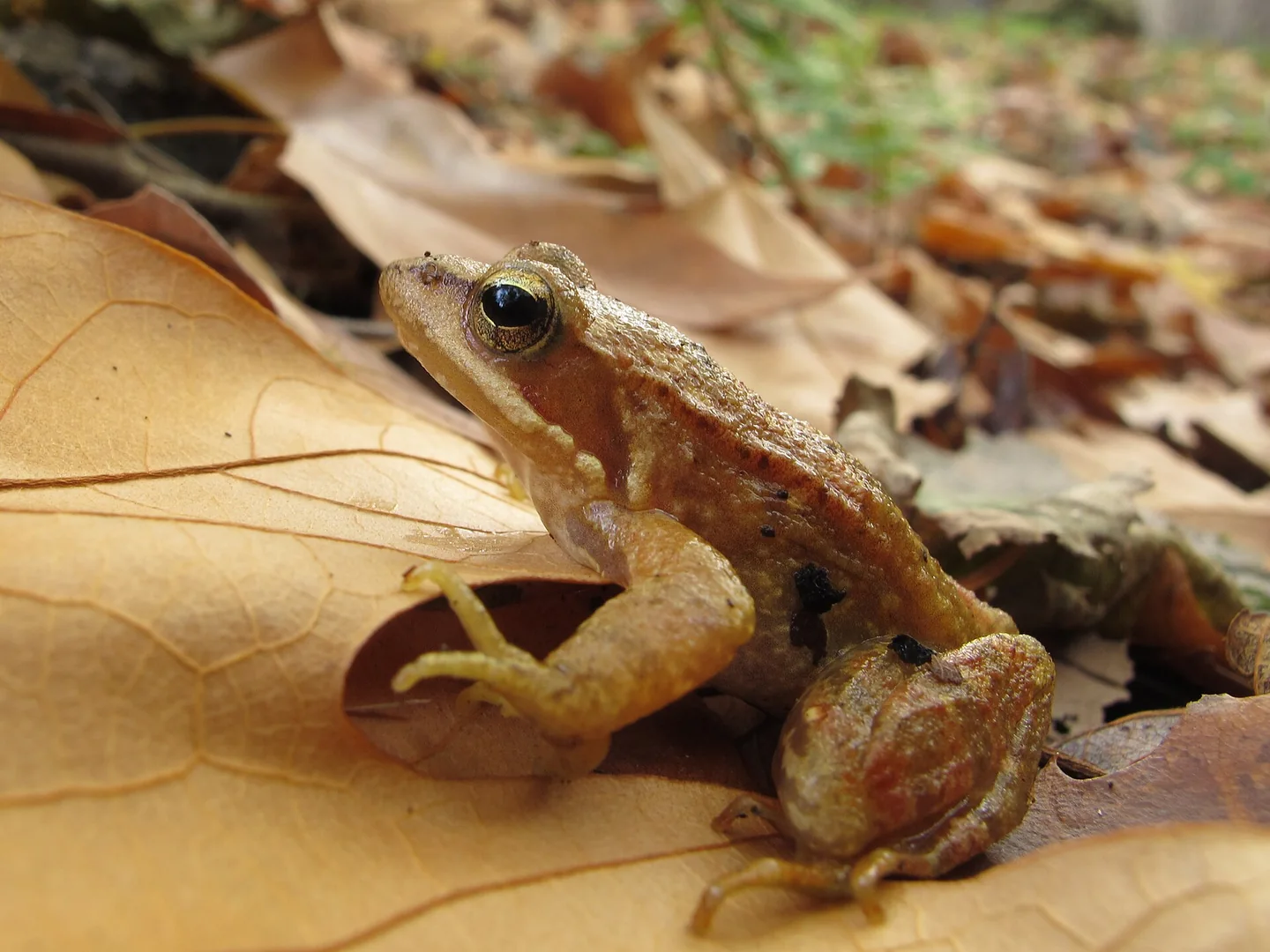
A small frog with a strong connection to water

Iberian frog among leaves.
Iberian frog among leaves.Illustrative photograph
jacilluch
ⓘ

Iberian frog among leaves.

Photography: jacilluch · CC BY-SA 2.0

View source

Date given at source: .

Request removal or correct the photo credit

Some lives depend on the bank as much as the stream.

The Iberian frog naturally lives in the Iberian Peninsula: that is what it means to be endemic to this territory. With a slender body and pointed snout, it can reach about 5.5 centimetres. Reproduction takes place in water, and the species prefers mountain streams with vegetation along the banks and rocky beds.

The photograph recorded in Rio Douro opens a window onto this discreet life. On its own, it does not demonstrate water quality: pollution and changes to riverside habitats are among the threats described by the University of Évora.

The description also highlights a dark stripe crossing the eye area, with a narrower pale stripe beneath. These are details to appreciate in a photograph without handling the animal.

One photograph opens other questions

Open an option and choose the story.

  1. What changes between larva and adult?The tail gives a clue →
  2. What does the skin do?A skin that also breathes →
  3. How do you evaluate a river?The life of the river also tells a story →
The register of Rio Douro documents this frog. The following readings explain biology and study methods; they do not document other animals in the same place.
Return to observation proposal ↑
Source and context

University of Évora — Virtual Museum of Biodiversity

Accessed: . Editorial summary; the date of consultation is not the date of the facts.

Back to index ↑
Serra da Cabreira · species biology

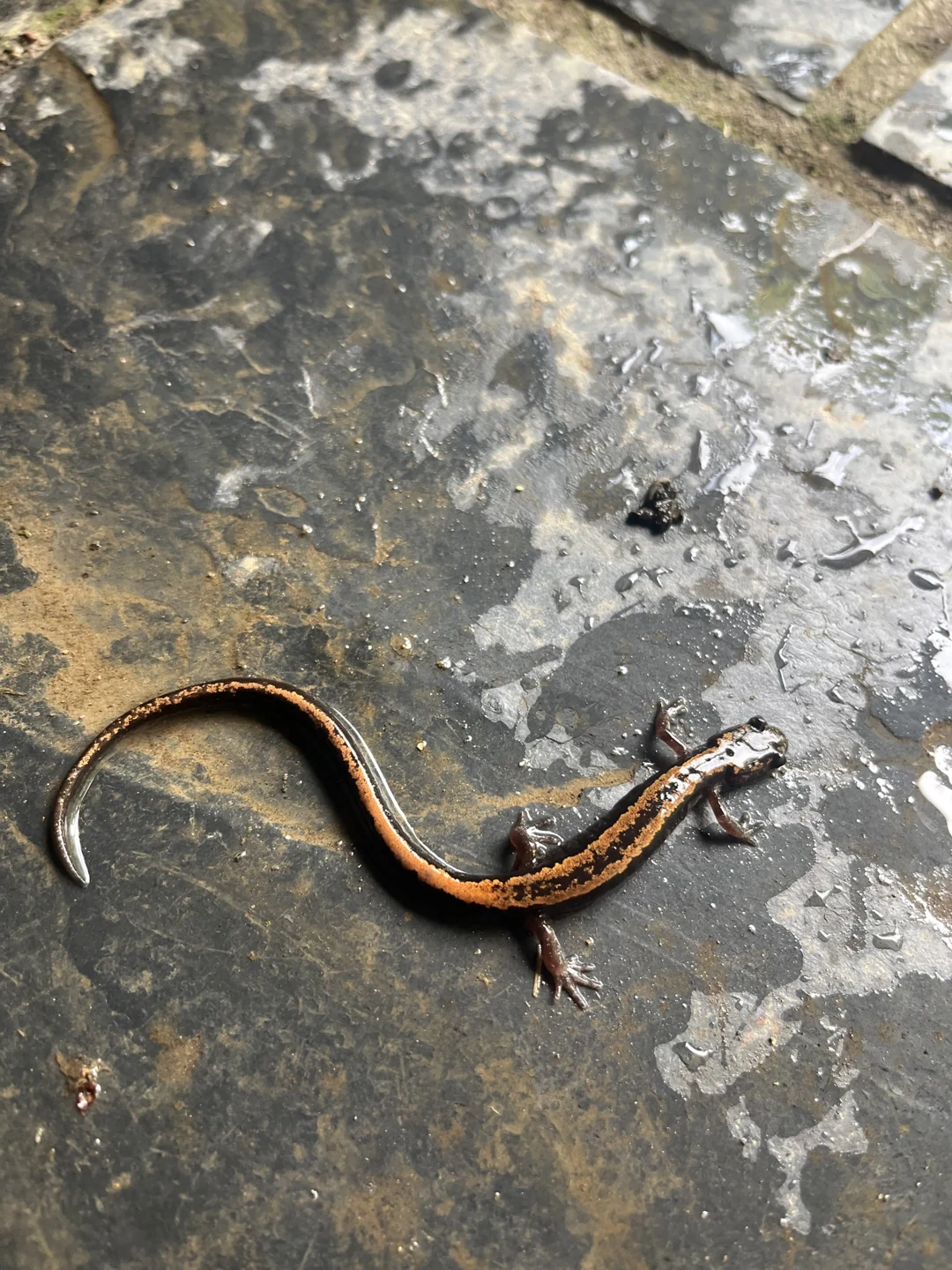
A tail longer than the body

Golden-striped salamander with its tail curved over a rock.
Golden-striped salamander with its tail curved over a rock.Illustrative photograph
Daniel Castanhal García
ⓘ

Golden-striped salamander with its tail curved over a rock.

Photography: Daniel Castanhal García · CC BY 4.0

View source

Date given at source: .

Request removal or correct the photo credit

The gold-striped salamander’s life is closely tied to moisture.

The gold-striped salamander, Chioglossa lusitanica, is mentioned by Visit Cabeceiras for Serra da Cabreira. It has a slender body, a tail longer than its body and two golden or orange stripes along its dark back.

According to LPN, vegetation influences how it uses space: in farmland and forests of exotic species it tends to stay closer to streams, while in native woodland it may move farther from water. The bank is therefore part of this amphibian’s story. This is species biology, not a sighting point.

It is endemic to the Iberian Peninsula and is nocturnal. Its front feet have four toes and its hind feet five: details that help us learn about the species without handling it.

Parque Biológico de Gaia describes a terrestrial life beside watercourses, abundant vegetation and high humidity, with a diet of small invertebrates. Being associated with streams does not mean spending its whole life swimming. When reading about eggs and larvae, compare the life stage with the habitat used: the relationship with water changes during development.

Source and context

Visit Cabeceiras — natural heritage of Serra da Cabreira
Accessed:

Gaia Biological Park — Chioglossa lusitanica
Accessed:

Link to Nature Protection — Salamander-lusitan
Accessed:

Editorial summary; the date of consultation is not the date of the facts.

Back to index ↑
Serra da Cabreira · species life cycle

Before the salamander, a life in water

The stream is also where the transformation begins.

The gold-striped salamander’s life begins in connection with water. LPN describes eggs often attached to the substrate and larvae that remain in quiet water until metamorphosis, in a development period that may last one to two years.

During this stage, they feed on small aquatic animals, including insects, molluscs and crustaceans. Pollution and habitat loss threaten this cycle; water and surrounding vegetation matter together. The story explains the biology of the species mentioned for Cabreira, without locating breeding areas.

Completing metamorphosis is not the same as becoming able to reproduce. LPN places male sexual maturity at around three to four years and female maturity between four and five. Body transformation and reproductive maturity are therefore distinct stages. These ranges describe species biology; they cannot predict the age of an individual seen in a photograph.

THREE MOMENTS OF THE SALAMANDRA-LUSITAN

Open every moment and compare what's happening.

  1. Eggs · start in water

    The laying depends on the watercourses. Eggs are often attached to the substrate.

  2. Larvas · transform the body

    The larval development to metamorphosis can last one to two years.

  3. Maturity · be able to reproduce

    LPN indicates about three to four years for males and four to five for females.

Intervals described by LPN for the species are not the age of a photographed animal or a breeding calendar for a local stream.
Source and context

Link to Nature Protection — Salamander-lusitan
Accessed:

Visit Cabeceiras — natural heritage of Serra da Cabreira
Accessed:

Editorial summary; the date of consultation is not the date of the facts.

Back to index ↑
Serra da Cabreira · general species behaviour

A tail that distracts a predator

The gold-striped salamander has a surprising defence.

When threatened, this salamander can shed its tail and regenerate it later. The detached part keeps moving, distracting the predator while the animal seeks shelter. Parque Biológico de Gaia describes this mechanism for the species mentioned by Visit Cabeceiras for Cabreira. It is something to learn about without touching or provoking the animal.

Parque Biológico de Gaia highlights this ability as unique among the salamanders of the Iberian Peninsula. The mechanism has two stages: immediate distraction by the detached tail, and later regeneration. These do not happen at the same time.

Compare this story with growth: losing part of the tail in defence and undergoing metamorphosis are different processes. A single photograph does not show the complete sequence of either. Learning about behaviour helps us understand the animal without trying to recreate a threatening situation.

Source and context

Gaia Biological Park — Chioglossa lusitanica
Accessed:

Visit Cabeceiras — natural heritage of Serra da Cabreira
Accessed:

Editorial summary; the date of consultation is not the date of the facts.

Back to index ↑
Serra da Cabreira · regional reference and species biology

A newt between water and land

Its skin also changes with its surroundings.

Bosca’s newt, Lissotriton boscai, has smoother skin during its aquatic phase and rougher skin during its terrestrial phase. For reproduction, it can use ponds, slow-flowing streams and even water tanks. Out of water it finds shelter in damp places among roots, stones and trunks. Its orange belly explains its Portuguese name, tritão-de-ventre-laranja.

It is mentioned among Cabreira’s amphibians by Vieira do Minho’s municipal website, without an associated observation point.

The University of Évora’s description notes four toes on the front feet and five on the hind feet, as well as a laterally flattened tail. These are species features, not a reason to take the animal out of the water. The same source gives a total length of up to nine centimetres, with females generally larger and more robust than males.

The mating season can change its appearance too. The University of Évora describes a small crest on the tail and, in males, a whitish lengthwise stripe, more marked near the tip. Comparing two images therefore means considering sex and season as well as species name. Not every visible difference means different species.

Diet follows the change of habitat. According to the Charcos com Vida project, larvae and aquatic adults catch small water-dwelling invertebrates; on land, adults mainly eat soft-bodied animals such as earthworms and slugs. The female lays eggs individually on aquatic plants or leaves over several days. The diagram below connects these stages without assigning dates to their occurrence in Cabreira.

From egg to change of environment

It opens every moment and discovers what the date represents.

  1. Posture · Separate eggs

    The female distributes the eggs individually to aquatic plants or leaves.

  2. Larvar phase · Food in water

    The larvae feed on small aquatic invertebrates.

  3. Adult phase · Between two environments

    Feeding varies between aquatic and terrestrial phases.

General cycle described by the Charcoes with Life. Some individuals can stay in the water all year, depending on the region.
Source and context

University of Évora — Virtual Museum of Biodiversity, Lissotriton boscai

Vieira Tourism of Minho — fauna of Serra da Cabreira, regional reference

Charcoals with Life / CIIMAR — Orange belly triton, life cycle and feeding

Accessed: . Editorial summary; the date of consultation is not the date of the facts.

Back to index ↑
Serra da Cabreira · regional reference and species biology

Some newts spend another winter in water

In the cold of higher ground, development can take longer.

In the palmate newt, Lissotriton helveticus, mating takes place in pond water. Parque Biológico de Gaia explains that in higher, colder areas, larvae may spend the winter in water before completing metamorphosis the following year. It feeds on small invertebrates. The municipal description of Cabreira mentions this species; the cycle described here is general biology, not reproduction observed in a local pond.

Two stages need to be distinguished. The Parque Biológico profile gives about fifteen days to a month between egg-laying and hatching; metamorphosis follows later. Hatching means leaving the egg, not completing larval development. The possibility of spending another winter in water shows why one calendar does not fit every set of conditions.

Source and context

Gaia Biological Park — Spanked Triton, Lissotriton helveticus

Vieira Tourism of Minho — fauna of Serra da Cabreira, regional reference

Accessed: . Editorial summary; the date of consultation is not the date of the facts.

Back to index ↑
YOUR LOCAL GUIDE

What would you like to discover?

Take a closer look.