Discover Cabeceiras de BastoFree independent guide
ViveCabeceirasYOUR GUIDE TO CABECEIRAS
ENEnglish
SearchSaved
CHOICE · EXPERIMENTARY · TAKE

Your notebook

Choose up to six ideas, try them and take your discoveries with you.

2 de 6 propostas escolhidas · faça-as ao seu ritmo.

PROPOSTA 1 DE 2 · A world beneath the leaves

Draws the food path

Reorder or remove

General biology · feeding of fungi

Vamos experimentar?

  1. Draws three boxes: organic matter, simple compounds and hyphae. Connects them and indicates where the enzymes act.
  2. It adds two zones to the drawing: one rich in food and another poor. It represents branching differences.
  3. Draws two separate pieces of wood and a cord that binds them. Compares this model with the explanation of the rhizomorphs.

A paper experience, without cultivating fungi or collecting specimens.

Discover the story

A meal prepared on the outside

A fungus does not need to swallow a leaf to use its nutrients. The mycelium releases enzymes outside itself; these break organic matter into simpler compounds, which the hyphae then absorb. The network of threads also grows and branches. Connections between hyphae allow nutrients to travel to other parts of the mycelium. Something that seems motionless may therefore be exploring new spaces and redistributing resources without a mushroom appearing on the surface. Growth also follows the distribution of food. The Australian National Botanic Gardens describe more branching and slower advance in nutrient-rich areas; where nutrients are scarce, hyphae may lengthen faster and branch less. The network does not always need the same density. Some fungi form cords of hyphae called rhizomorphs. These can help cross gaps between food sources, such as two separate pieces of wood. On reaching fresh wood, the hyphae may branch and occupy it. This explains growth strategies, not a confirmed description of any thread found on a walk.

Open a história e os seus recursos →
Sources of this proposal

My findings

An idea, a drawing or a question to go on.
PROPOSTA 2 DE 2 · Travel through time

Try observing

Reorder or remove

Gondiães and Vilar de Cunhas · memory and landscape

Vamos experimentar?

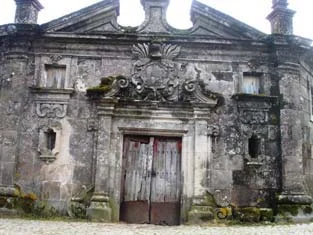
  1. Look at the photo of the portal and list only the elements you can see.
  2. Compared to the three granaries mentioned in the text: what depends on the written description?
  3. Imagine a caption that distinguishes the frame of the photograph from the remaining patrimonial set.

An activity to try at your own pace, without collecting specimens.

Discover the story

A house with three granaries

At Casa de Chouzas, three 19th-century granaries stand alongside the manor house highlighted by the municipality. The group connects two functions: living and storing the harvest. Rather than looking only at the main house, it is worth recognising the importance of buildings supporting agriculture. The introduction to Vilar de Cunhas places this heritage in a landscape of plateau and mountain, shaped by farming and pastoralism. House and granaries can be read in that working context, although the source does not detail each property’s production. The house’s dating is less firm: the municipality presents it as perhaps 19th-century, while assigning the granaries to the 19th century. That difference should remain visible. The photograph accompanying the reading shows the portal, not the three granaries. The heritage reference does not confirm access to the group.

Municipal archive photograph: Casa de Chouzas.
Portal da Casa de Chouzas · photo of the municipal inventory; the granaries do not appear in this framework.ⓘ
Open a história e os seus recursos →
Sources of this proposal

My findings

An idea, a drawing or a question to go on.

YOUR LOCAL GUIDE

What would you like to discover?

Take a closer look.