Discover Cabeceiras de BastoFree independent guide
ViveCabeceirasYOUR GUIDE TO CABECEIRAS
ENEnglish
SearchSaved
CHOICE · EXPERIMENTARY · TAKE

A notebook.
Your findings.

Up to six proposals of Cabeceiras, in your own order, to do it at home, in company or on a break.

3 de 6 propostas escolhidas · faça-as ao seu ritmo.

PROPOSTA 1 DE 3 · Life you do not always see

Try observing

General biology · aquatic insects, without a local species inventory

Tiny shelters beneath the water

Caddisfly larvae live in water; many build shelters from sand or plant fragments. They form part of river and stream food webs, providing food for fish, birds and amphibians. The Tagis guide highlights their usefulness as ecological indicators. Finding one individual, however, does not certify water quality on its own. The submerged shelter is only part of the story. The adult has hairy wings and slender antennae, and holds its wings like a small roof over its body when resting. It may resemble a butterfly or moth, but those have scales on their wings. Adult caddisflies usually fly around dusk and live near freshwater bodies. There is no single menu for all larvae either: depending on the group, they may eat algae, plants, organic remains or other invertebrates. They are consumers and, at the same time, food for other animals. A food web describes these relationships better than a line assigning just one food to each species.

Vamos experimentar?

  1. Observe the water from an accessible and stable margin.
  2. Look for differences between sand, vegetable remains and small shelters without collecting them.
  3. If you do not distinguish any, save the question for an accompanying activity.

An activity to try at your own pace, without collecting specimens.

Open a história e os seus recursos →
Sources of this proposal

My findings

An idea, a drawing or a question to go on.
PROPOSTA 2 DE 3 · Life you do not always see

A Transforming Family

Occurrence mentioned in the environmental document

The Iberian wolf

The environmental assessment of the municipal master plan records a wolf pack in the area, based on ICNF information. This reflects Cabeceiras’s ecological importance; it is not a promise of a sighting. Learning about this presence does not require searching for the animals or revealing their shelters. The national platform links a shortage of wild prey with livestock consumption and conflict with pastoral communities. It presents protecting flocks and restoring natural prey as complementary parts of conservation. A pack is also a family that changes. The platform describes a breeding pair, offspring from different years and sometimes other related adults. The group defends a territory, but its composition changes through births, growth and dispersal. In the general cycle described for Portugal, pups are born in late April or May. During summer, rendezvous sites become centres of family activity; in autumn, the young begin accompanying adults as they travel and hunt. This is not an observation calendar for a particular pack. As they grow, some young wolves leave their original group to seek a territory, a mate or another pack. Others stay longer when enough food is available. A count at one moment therefore does not describe an unchanging family: social life follows the annual cycle and the opportunities offered by the landscape.

Vamos experimentar?

  1. Draws a family group with adults and pups from the description.
  2. Add arrows to represent growth and output of young people from the group.
  3. Compare two moments of the drawing: what would change in a countdown?

General biology scheme; it does not represent the number of wolves in a local pack.

Open a história e os seus recursos →
Sources of this proposal

My findings

An idea, a drawing or a question to go on.

PROPOSTA 3 DE 3 · Travel through time

Try observing

Gondiães and Vilar de Cunhas · memory and landscape

A house with three granaries

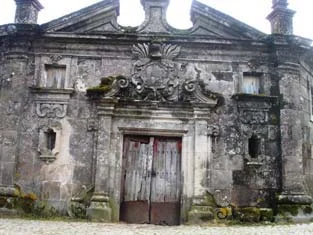
At Casa de Chouzas, three 19th-century granaries stand alongside the manor house highlighted by the municipality. The group connects two functions: living and storing the harvest. Rather than looking only at the main house, it is worth recognising the importance of buildings supporting agriculture. The introduction to Vilar de Cunhas places this heritage in a landscape of plateau and mountain, shaped by farming and pastoralism. House and granaries can be read in that working context, although the source does not detail each property’s production. The house’s dating is less firm: the municipality presents it as perhaps 19th-century, while assigning the granaries to the 19th century. That difference should remain visible. The photograph accompanying the reading shows the portal, not the three granaries. The heritage reference does not confirm access to the group.

Municipal archive photograph: Casa de Chouzas.
Portal da Casa de Chouzas · photo of the municipal inventory; the granaries do not appear in this framework.ⓘ

Vamos experimentar?

  1. Look at the photo of the portal and list only the elements you can see.
  2. Compared to the three granaries mentioned in the text: what depends on the written description?
  3. Imagine a caption that distinguishes the frame of the photograph from the remaining patrimonial set.

An activity to try at your own pace, without collecting specimens.

Open a história e os seus recursos →
Sources of this proposal

My findings

An idea, a drawing or a question to go on.

YOUR LOCAL GUIDE

What would you like to discover?

Take a closer look.