Discover Cabeceiras de BastoFree independent guide
ViveCabeceirasYOUR GUIDE TO CABECEIRAS
ENEnglish
SearchSaved
CHOICE · EXPERIMENTARY · TAKE

A notebook.
Your findings.

Up to six proposals of Cabeceiras, in your own order, to do it at home, in company or on a break.

3 de 6 propostas escolhidas · faça-as ao seu ritmo.

PROPOSTA 1 DE 3 · Travel through time

Try observing

Gondiães and Vilar de Cunhas · memory and landscape

A house with three granaries

At Casa de Chouzas, three 19th-century granaries stand alongside the manor house highlighted by the municipality. The group connects two functions: living and storing the harvest. Rather than looking only at the main house, it is worth recognising the importance of buildings supporting agriculture. The introduction to Vilar de Cunhas places this heritage in a landscape of plateau and mountain, shaped by farming and pastoralism. House and granaries can be read in that working context, although the source does not detail each property’s production. The house’s dating is less firm: the municipality presents it as perhaps 19th-century, while assigning the granaries to the 19th century. That difference should remain visible. The photograph accompanying the reading shows the portal, not the three granaries. The heritage reference does not confirm access to the group.
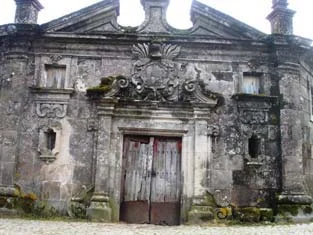
Municipal archive photograph: Casa de Chouzas.
Portal da Casa de Chouzas · photo of the municipal inventory; the granaries do not appear in this framework.ⓘ

Vamos experimentar?

  1. Look at the photo of the portal and list only the elements you can see.
  2. Compared to the three granaries mentioned in the text: what depends on the written description?
  3. Imagine a caption that distinguishes the frame of the photograph from the remaining patrimonial set.

An activity to try at your own pace, without collecting specimens.

Open a história e os seus recursos →
Sources of this proposal

My findings

An idea, a drawing or a question to go on.

PROPOSTA 2 DE 3 · A world beneath the leaves

Try observing

General knowledge · national guide

The mushroom is only one part

A mushroom is a reproductive structure; the body of many fungi is a network of threads called mycelium. Each thread is a hypha. CCRES describes this network colonising living or decaying organic matter, from which the fungus obtains nutrients. The fruiting body develops from the mycelium and allows spores to disperse. If conditions are favourable, they can give rise to new mycelium. The visible mushroom tells only part of the life cycle; not all fungi produce cap-shaped structures. When some decomposer species are cultivated, mycelium can develop in inoculated logs. The same log can produce mushrooms for several years while conditions and nutrients remain suitable. This general explanation neither identifies a species nor documents its occurrence in Cabeceiras. The network can also form cords called rhizomorphs. In certain wood-inhabiting fungi, these help bridge gaps between branches or logs to reach another food source. An outer layer protects the inner hyphae during this exploration. Another strategy is to form sclerotia: compact masses of hyphae with a resistant covering. They allow fungi to survive unfavourable periods and, when conditions improve, can produce mycelium or reproductive structures. These are forms of growth and survival described by the Australian botanic gardens, not local records.

Vamos experimentar?

  1. Draw a network of wires on paper and, above, a mushroom.
  2. Tick the net as mycelium and choose a wire to represent a hyphae.
  3. Use the drawing as a scheme: it does not represent the shape or size of a real fungus.

An activity to try at your own pace, without collecting specimens.

Open a história e os seus recursos →
Sources of this proposal

My findings

An idea, a drawing or a question to go on.

PROPOSTA 3 DE 3 · Between rivers and mountains

Water that moves and water that is distributed

Saint Nicholas · hydraulic heritage inventoryed in 2008

The Peio made flour too

The Levada do Casal record notes water drawn from the Peio near Ponte do Gado, in Gondarém. The inventory describes five mills along the channel. It is a record of water-powered heritage, not confirmation that the mills operate or are publicly accessible today. The survey of 26 February 2008 identifies a channel in natural ground and two shared users: Casa do Casal and Quinta do Rapazinho, the latter with less irrigation time. It also describes the route near the Levada de Bouças and a boundary marker in Sendim placed to settle a disagreement over use. The channel carried water, but its use also depended on agreements between people.

Vamos experimentar?

  1. Draw a channel and five mill symbols, such as inventory scheme of 2008.
  2. Add two cards to Casa do Casal and Quinta do Boyinho, without assigning watering durations that the reading does not provide.
  3. It distinguishes the physical elements of the channel of agreements between users.

Proposal on paper or on screen, from reading and its sources. It does not require visit, collection of objects or confirmation of current conditions.

Open a história e os seus recursos →
Sources of this proposal

My findings

An idea, a drawing or a question to go on.

YOUR LOCAL GUIDE

What would you like to discover?

Take a closer look.